What Is Sleep Training? A Gentle, Research-Backed Guide

We may earn a commission for purchases made using our links. Please see our disclosure to learn more.
You’re tired (like, “Where did I put the coffee…in the fridge?” tired). Your baby’s sweet, but your nights feel like a game of musical chairs with zero chairs. If you’ve been wondering what is sleep training and whether it can help your family sleep more, breathe easier, and feel like yourselves again—you’re in the right place.
In this friendly, judgment-free guide, we’ll unpack what sleep training actually means (no, it’s not one method or a “cry-it-out” mandate), how to tell if you and your baby are ready, the most common methods, and a practical plan you can try. We’ll also look at research, tools, and gentle troubleshooting. By the end, you’ll know how to choose an approach that fits your baby’s temperament, your culture and values, and your energy level—because sleep is personal.
What Is Sleep Training?
At its core, sleep training is the process of helping your baby learn independent sleep skills—like falling asleep without being fully fed/rocked to sleep and linking sleep cycles overnight. It’s not a single method; it’s an umbrella term for strategies that help babies settle at bedtime and during night wakings.
Think of it like teaching your little one to ride a bike with training wheels: you support, you scaffold, and you slowly step back as they gain balance. “Sleep training” can be responsive and gradual or more structured—the right choice depends on your baby and your comfort level.
How Baby Sleep Develops (0–12 Months)
Newborns come with tiny stomachs and developing circadian rhythms. In the early weeks, frequent night waking is biologically normal. Around 3–4 months, sleep cycles mature, and patterns begin emerging. By 6 months (give or take), many babies can handle slightly longer stretches, and you can start shaping independent sleep with gentle consistency.
Benefits—For Babies and Parents
- Babies learn to settle with less help, so they get longer, more restorative stretches of sleep.
- Parents get predictability, which lowers stress and supports mental health.
- Families gain flexibility (caregivers can trade off bedtime, siblings still get attention, etc.).
Sleep training isn’t a magic wand; it’s a set of repeatable habits that help everyone rest better.

Is Sleep Training Right for Your Family?
Ask yourself:
- What are your values around soothing and crying?
- What does your support system look like?
- What’s your baby’s temperament—slow-to-warm, go-with-the-flow, sensitive?
- What’s your current bandwidth? (Gentle approaches often take longer but feel easier emotionally.)
There’s no single “right way.” There’s your way.
Myths vs. Reality
- Myth: Sleep training = “cry it out.”
Reality: There are many responsive methods—from “chair method” to “pick up/put down”—that allow frequent check-ins. - Myth: Sleep training harms attachment.
Reality: Well-designed studies have found no long-term harm to attachment or emotional health when families use behavioral sleep strategies appropriately (more on this in the research section). - Myth: You must do it at 4 months or it’s “too late.”
Reality: You can teach sleep skills at many ages. Toddlers can learn, too, though expectations and tactics shift.
Sleep Training Methods (Overview)
You can combine and adapt these to your baby’s age and your comfort level:
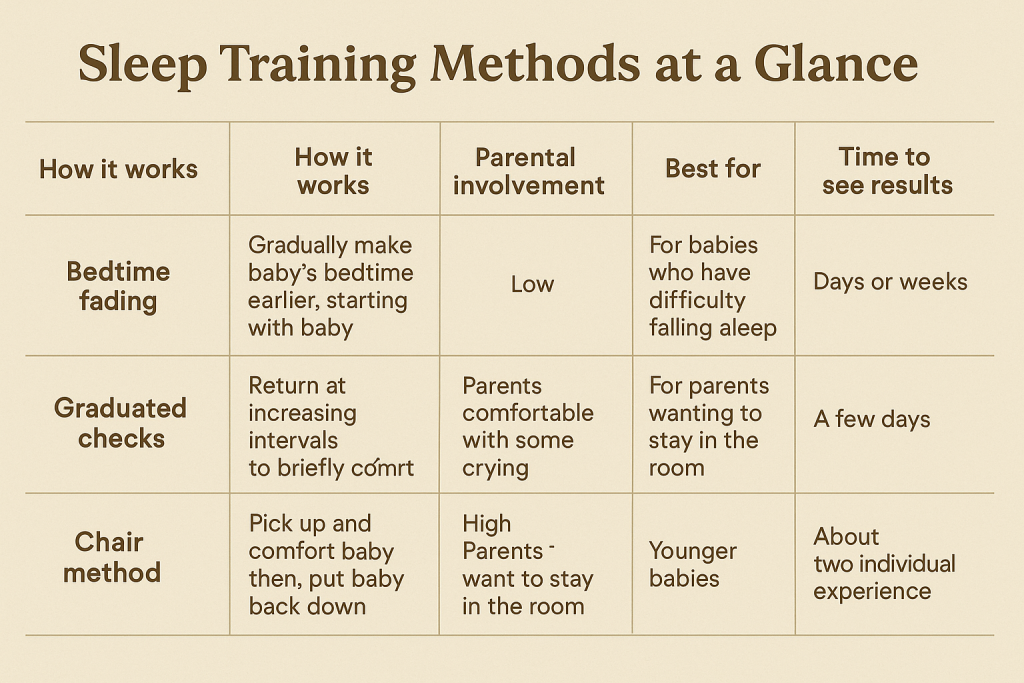
- Bedtime Fading: Shift bedtime later temporarily to match natural sleep pressure, then move earlier in 10–15 minute steps.
- Graduated Checks (a.k.a. Ferber): Place baby down drowsy-but-awake, then offer brief, timed check-ins that get slightly longer between visits.
- Chair Method: Sit beside the crib and gradually move your chair farther away over days.
- Pick Up/Put Down: Soothe by picking up until calmer, then place back in crib while drowsy; repeat as needed.
- Response-Based (“No Timers”): You respond as often as you like, but keep interventions brief and consistent to avoid fully re-starting sleep associations.
Tip: Choose one primary method and stick with it for 5–7 nights before judging results, unless you spot a red flag (see below).
When to Start—and When to Wait
Many families experiment with gentle shaping around 4–6 months, once nights consolidate and weight gain is steady. But readiness matters more than age.
Readiness Signs
- Bedtime takes >30 minutes or lots of rocking/feeding to sleep
- Short, fragmented naps and frequent night wakings (beyond feeding needs)
- Predictable wake windows emerging (e.g., 2–3 hours for older infants)
Red Flags
- Poor weight gain, reflux flares, or illness
- Major transitions this week (immunizations, travel, a new caregiver)
- Your gut says “not now”—that matters
If your baby constantly fights sleep, check for sleep debt. Here’s a helpful internal resource on the signs of an overtired baby that might be sabotaging bedtime—addressing over-tiredness can make training so much easier: spotting the signs of an overtired baby.

Optimize the Sleep Environment
- Darkness: Blackout curtains reduce visual stimulation and early light.
- Sound: A steady white noise masks household noise and helps cue sleep.
- Temperature: Aim for a comfortable, safe sleep environment (often ~20–22°C / 68–72°F).
- Wearables: A sleep sack (not loose blankets) can become a calm, safe cue.
Build a Predictable Bedtime Routine
Keep it short, sweet, and repeatable:
- Dim lights, diaper, sleep sack
- Feed (if part of your routine), burp, gentle cuddle
- Brief book or song
- Into bed drowsy but awake with a simple verbal cue (“It’s sleepy time. I love you.”)
Consistency turns routines into powerful sleep associations.
Naps, Wake Windows & Night Sleep
Day sleep and night sleep are dance partners. Watch wake windows (the time baby is comfortably awake between sleeps) and adjust by age. An overtired baby often wakes more at night; conversely, too much day sleep can also fragment nights. Track for a few days to spot patterns before you tweak.
A Gentle Seven-Day Starter Plan
Day 1–2: Prep
- Tighten the routine; pick your method; set realistic goals.
- Choose a bedtime that matches real sleep pressure (not too early).
Day 3–4: Consistency
- Use your chosen method from bedtime through first night waking.
- Keep interventions short and predictable.
Day 5–6: Extend
- Apply the same responses to subsequent wakings if baby isn’t hungry.
- For feeds, try to separate feeding and falling asleep (feed, burp, then a minute of calm in low light before down).
Day 7: Review
- What changed? Faster settling? Longer first stretch? Celebrate any progress.
- Adjust one variable at a time (bedtime 10–15 minutes earlier/later, or countdown timers for checks).
Troubleshooting Common Roadblocks
- False starts (wakes 20–40 minutes after bedtime): Bedtime may be too early or nap schedule needs a tweak.
- Early mornings (4–5 a.m.): Guard the last nap, keep room very dark, and avoid starting the day too early.
- Illness/teething: Prioritize comfort. It’s okay to pause training and resume when baby’s better.
- Travel/regressions: Keep one or two “sleep anchors” (same phrase, same sound machine) and give 2–3 days to reset when home.
- Parental stress: Trade off nights or roles. A calmer parent is a more consistent parent.
Research-Backed Insights on Sleep Training
If you’ve asked yourself what is sleep training and whether it’s safe, here’s what high-quality research says:
- A randomized controlled trial found that graduated extinction and bedtime fading significantly improved infant sleep (shorter time to fall asleep, fewer night wakings) without adverse effects on stress or attachment. Read the RCT summary via the American Academy of Pediatrics journal: Behavioral Interventions for Infant Sleep Problems (2016).
- A five-year follow-up study reported no long-lasting harms or benefits to child emotional health, parent–child relationship, or maternal well-being after families used behavioral sleep strategies. See: Five-Year Follow-up of Behavioral Infant Sleep Intervention (2012).
Together, these findings suggest that when families use age-appropriate, consistent strategies, sleep training can improve sleep without harming attachment or development.
Tools to Support Sleep Training (Amazon Picks)
These tools are optional—not requirements—but they can make consistency easier. I selected widely used, budget-friendly items plus one or two “nice-to-have” upgrades.
1) Hatch Rest 2nd Gen Sound Machine & Night Light
Why it helps: Stable white noise and a dim, colored night light create strong sleep cues from infancy through toddlerhood. App scheduling lets you automate bedtime and “okay-to-wake” for older babies.
Features: White/pink/brown noise, customizable light, app control, routines.
Pros: Grows with child; set-and-forget schedules; reliable volume.
Cons: App dependence; requires outlet.
Warranty: 1-year limited warranty.
Use for: Newborns to preschoolers; families who love routines.
Review snapshot: Parents praise the automation and toddler “time-to-rise.” Occasional complaints mention app connectivity.
Note: In 2024, a recall affected some 1st-gen power adapters—not the device itself. Check your adapter model and request a free replacement if relevant.
2) NICETOWN 100% Blackout Curtains
Why it helps: Darkness supports melatonin and prevents early-morning light from waking baby.
Features: Thick triple-weave fabric; multiple sizes/colors.
Pros: Budget-friendly; noticeable darkening; pairs well with blinds.
Cons: Warranty details vary by seller.
Warranty: Not clearly specified on listing; check seller’s warranty link.
Use for: Nurseries with streetlight or sunrise issues.
Review snapshot: Buyers love the blackout effect for naps; occasional notes about size or color variance.
3) LOVE TO DREAM Swaddle UP (Stage 1)
Why it helps: “Arms-up” design lets babies self-soothe while staying safely swaddled (no loose blankets).
Features: Two-way zipper; hip-healthy design; size and TOG options.
Pros: Easier transitions; many babies settle faster.
Cons: Not for rolling babies; size-specific.
Warranty/Returns: Amazon 30-day return window; manufacturer warranty not listed—check seller.
Use for: 0–3 months (or per size chart) before rolling.
Review snapshot: Parents love the quick zip and soothed startle reflex; a minority find fit tricky between sizes.
4) HALO SleepSack Wearable Blanket
Why it helps: A wearable blanket becomes a strong sleep cue and keeps baby warm safely post-swaddle.
Features: Multiple fabrics/TOGs; roomy hip design.
Pros: Easy, safe alternative to blankets; affordable.
Cons: Sizing runs can vary by fabric.
Warranty/Returns: Amazon 30-day return window; manufacturer warranty not listed on this page—confirm with seller.
Use for: 3–24 months (check size and TOG).
Review snapshot: Highly rated for ease and safety; occasional notes about shrinkage after washing depending on fabric.
5) VTech DM221 Audio Baby Monitor
Why it helps: Reliable audio and long range so you can respond promptly without hovering.
Features: 2-way talk, night light on baby unit, ~1,000 ft range.
Pros: Budget-friendly; simple interface; clear sound.
Cons: No video; fewer “smart” features.
Warranty: Manufacturer 1-year limited warranty.
Use for: Families who prefer a straightforward, low-maintenance monitor.
Review snapshot: Most appreciate clarity and value; some wish for a rechargeable dock upgrade.
Quick Comparison
| Model | Key Spec(s) | Warranty | Approx Price/Tier | Best For |
| Hatch Rest 2nd Gen | White noise + night light + app routines | 1-year limited | Mid ($70–$90) | Schedules, toddler “okay-to-wake” |
| NICETOWN Blackout Curtains | Triple-weave blackout panels | Varies by seller | Budget ($20–$40/pair) | Early-light rooms, naps |
| LOVE TO DREAM Swaddle UP | Arms-up swaddle, two-way zip | Not specified; 30-day returns | Mid ($30–$40) | Newborn soothe-and-settle |
| HALO SleepSack | Wearable blanket, TOG options | Not specified; 30-day returns | Budget–Mid ($25–$45) | Safe warmth after swaddle |
| VTech DM221 Monitor | 1,000-ft audio range, 2-way talk | 1-year limited | Budget ($30–$45) | Simple, reliable monitoring |
(Prices vary by size/color and promotions.)
Quick Answers: Sleep Training FAQs
How long does sleep training take?
Many families see meaningful progress in 3–7 nights with consistent routines and a single method. Gentle paths may take a couple of weeks—still worth it if it aligns with your values.
Can I sleep train while feeding at night?
Yes. You can still offer age-appropriate feeds and separate feeding from falling asleep (feed, burp, brief cuddle, then into bed). Over time, many babies consolidate feeds naturally.
Does sleep training mean I ignore crying?
No. It means you respond on a plan—with check-ins, verbal reassurance, or brief pick-ups—while giving baby chances to practice self-settling. You remain responsive and consistent.
What if naps are a mess?
Start with bedtime (it’s biologically easier). Once nights stabilize, tackle naps with the same method. Protect naps with dark room + white noise, and watch wake windows.
What age is ideal to begin?
There’s a best fit for your baby. Many start shaping sleep around 4–6 months; others wait longer. If you’re not ready, begin with routine, environment, and gentle pauses before picking up.
Final Thoughts
If you came here asking what is sleep training, I hope you’re leaving with clarity and confidence. Sleep training is not a one-size-fits-all program; it’s a toolbox. You can be responsive, loving, and consistent—and you can choose a method that honors your baby’s cues and your caregiving style.
Start small. Celebrate tiny wins (a shorter settle, one longer stretch). Adjust with compassion—for your baby and yourself. You’ve got this.