Sleep Sack vs Swaddle: Key Differences Every Parent Should Know
We may earn a commission for purchases made using our links. Please see our disclosure to learn more.
You know that moment at 2:13 a.m. when your baby finally falls asleep… and you’re scared to breathe because anything could wake them? Yeah. That’s usually when the sleep sack vs swaddle debate shows up in your brain like an uninvited guest.
Here’s the good news: you don’t have to pick a “perfect” option. You just need the option that fits your baby’s age, personality, and sleep stage—and keeps things safe.
You’re about to learn the real differences (comfort, safety, timing, and transition tips), plus how to choose without overthinking it.
Affiliate note: If you buy through product links below, I may earn a small commission at no extra cost to you.
Sleep sack vs swaddle in plain English
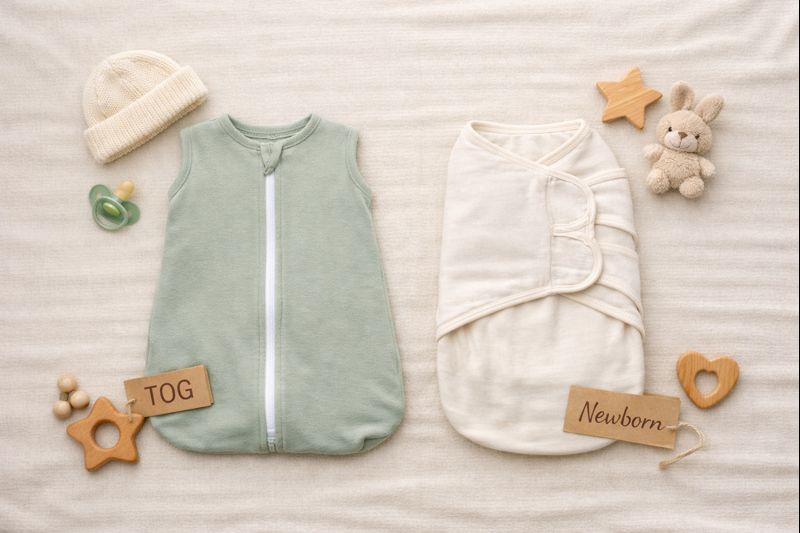
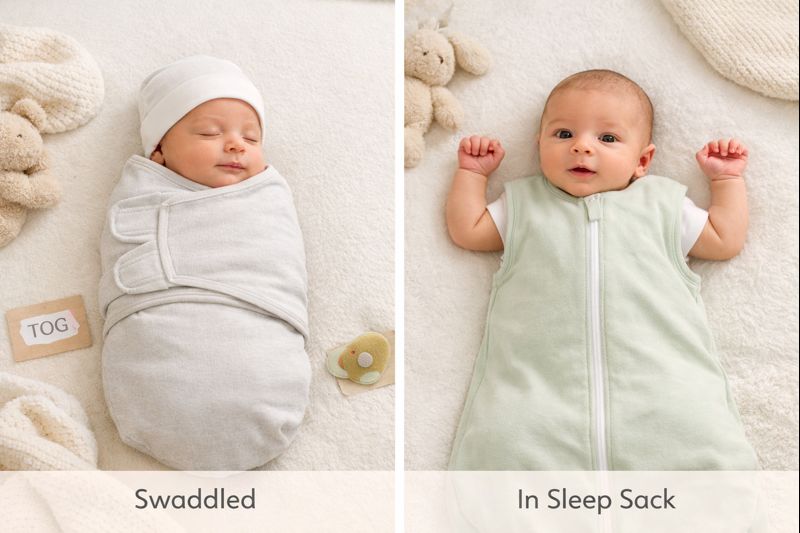
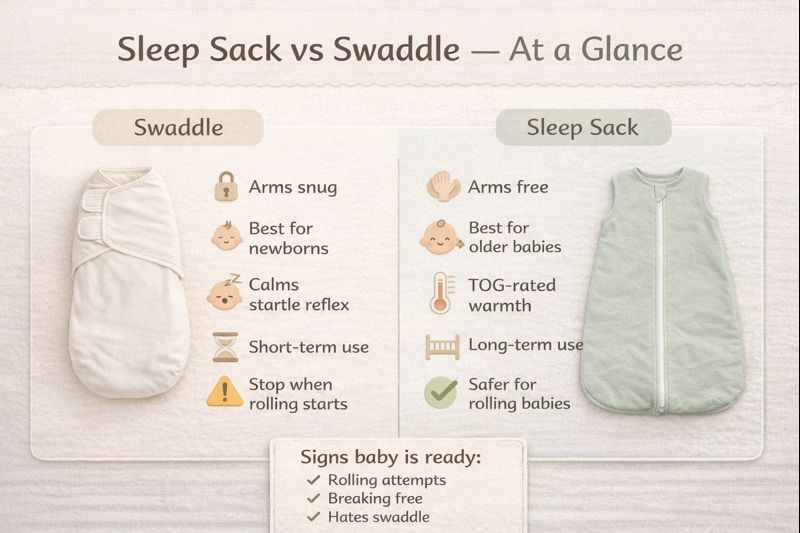
A swaddle is a snug wrap (blanket or wrap-style product) that keeps baby’s arms close to their body, which can calm the startle reflex.
A sleep sack (also called a wearable blanket) is like a cozy, sleeveless sleeping bag your baby wears—arms free, legs tucked inside, no loose blankets.
The vibe:
- Swaddle = “huggy burrito”
- Sleep sack = “tiny wearable comforter”
Neither is “best” for every baby. They’re tools for different phases.
The biggest difference: arms and the startle reflex
Newborns often have a strong Moro (startle) reflex—those sudden arm flings that can wake them up like they just heard a jump-scare sound effect.
Why swaddles can feel magical early on
A good swaddle helps by:
- Limiting sudden arm movements
- Creating gentle pressure that feels womb-like
- Helping baby settle faster after being put down
Why sleep sacks win later
Sleep sacks help by:
- Keeping baby warm without loose blankets
- Letting arms move normally (which matters more as baby grows)
- Making rolling and repositioning safer than being swaddled once rolling starts
If your baby loves to self-soothe by sucking hands, arms-up styles can be a nice middle ground early on.
Safety first: what “safe sleep” actually means here
Let’s keep this simple and real: the “right” choice only works if it’s used safely.
Non-negotiables for either option:
- Baby sleeps on their back
- Crib/bassinet is empty (no loose blankets, pillows, bumpers)
- Fit is snug at the neck/arms so fabric can’t ride up
- Avoid overheating (more on that soon)
Swaddles need extra caution because if a swaddled baby rolls, it can become dangerous fast. Sleep sacks are usually the “next-stage safer” option once baby gets wiggly and roll-y.
Age-by-age guide: when to use swaddle vs sleep sack
Every baby is unique, but this timeline helps you stop guessing.
0–8 weeks: “Fresh human” phase
Many babies do well with a swaddle because the startle reflex is intense. If your baby hates being swaddled, you’re not failing—some babies just want arms free.
8–16 weeks: “Stronger + squirmier” phase
This is often the transition zone. Some babies still love swaddling, but many start fighting it or showing early rolling attempts.
Rolling signs = swaddle exit sign
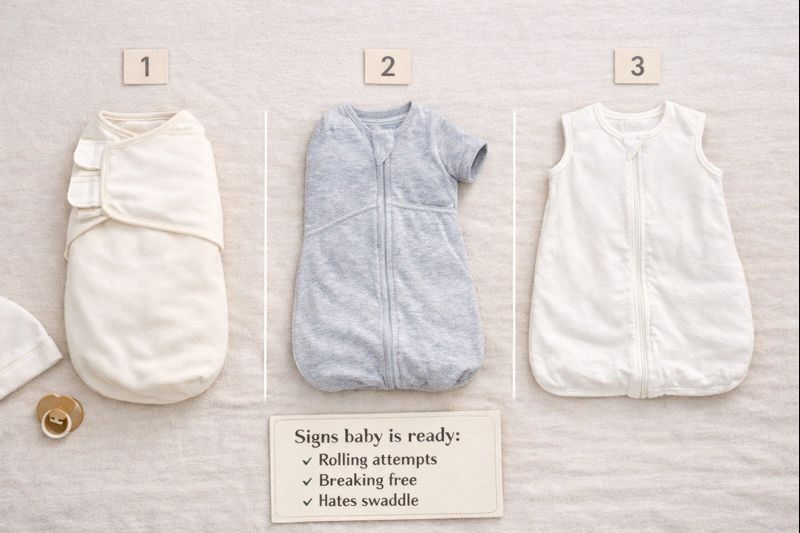
If baby shows signs of trying to roll (or actually rolls), it’s time to stop swaddling and move to arms-free sleep.
4+ months: “Movement era”
Most families lean toward sleep sacks here because they’re warm, simple, and safer with mobility.
The parent convenience factor
You deserve sleep too. Let’s talk practicality.
Swaddles: high reward, sometimes high effort
- Blanket swaddles take practice (and can loosen)
- Velcro/zip swaddles are easier, but sizing matters a lot
- Middle-of-the-night diaper changes can be… a whole event
Sleep sacks: “set it and forget it” energy
- Zip on, zip off
- Consistent fit night after night
- Great for caregivers, grandparents, and daycare because it’s straightforward
If you’re already running on fumes, sleep sacks tend to be the lower-maintenance long game.
Warmth and TOG: avoiding overheating without stress
Overheating is one of those parenting worries that can spiral. Here’s the calm version:
TOG is just a warmth rating for sleepwear.
- Lower TOG = lighter (warm climates / warm rooms)
- Higher TOG = warmer (cool rooms)
A practical rule that helps
Dress baby in one more light layer than you’d wear to be comfy in that room.
Examine the baby’s back and chest, not their hands or feet, to check for excessive heat or perspiration.
Swaddle tip: Swaddles can trap heat quickly, especially if you add blankets (please don’t) or layer too much.
Sleep sack tip: Choose the TOG based on room temp and keep layers simple.
Hip health and freedom of movement
A swaddle should be snug up top and loose around the hips and legs—baby needs room to bend and move.
If the legs are wrapped straight and tight, that’s not ideal for hip positioning.
Sleep sacks naturally allow more lower-body movement, which is one reason many parents feel more relaxed using them long term.
Sensory needs: babies who love snug vs babies who fight it
Some babies melt into snug pressure like, “Ah yes, finally, peace.”
Others react like, “UNHAND ME, PEASANT.”
If your baby fights swaddling:
- Try arms-up styles (hands near face can be calming)
- Try a lighter wrap (some babies hate feeling too pinned)
- Or skip swaddling entirely and use a sleep sack early—some newborns do fine
If your baby needs snug:
- Swaddling might be your best early tool
- Transition products can help later (one arm out → both arms out)
Breastfeeding, reflux, and wake-ups
This isn’t medical advice—just real-world patterns parents notice.
Swaddles can help with settling…
…but some babies get frustrated if they want hands for self-soothing.
Sleep sacks can support natural movement
If your baby wakes often and tries to rub their face, suck fingers, or adjust positions, arms-free sleep can sometimes reduce that frustration.
For refluxy babies: the key isn’t swaddle vs sack—it’s safe sleep positioning (flat, on back) and following your pediatrician’s guidance.
Transition plan: swaddle to sleep sack without chaos
This is where most parents panic, so let’s make it feel doable.
Step-by-step transition that’s gentle
- Start with naps in a sleep sack (lower pressure than nighttime)
- One arm out for 2–3 nights (if using a swaddle product)
- Both arms out for 2–3 nights
- Switch fully to a sleep sack
If you want the fast method
Some babies do better with a clean break:
- Swaddle → sleep sack, cold turkey
- Expect 2–4 nights of “what is this new reality”
- Then it often clicks
Tip: keep everything else the same—same bedtime routine, same white noise, same lights.
Troubleshooting: if sleep gets worse before it gets better
Totally normal. Transition can look like:
- Shorter stretches
- More startles
- More soothing needed
Try these quick fixes
- Make sure baby isn’t cold (sleep sacks can feel “less snug”)
- Increase soothing at bedtime (rocking, patting, a longer wind-down)
- Use a consistent bedtime cue (“Okay love, it’s sleep time.” Same words nightly.)
- Give it a few nights before switching strategies again
You’re not “ruining sleep.” You’re teaching a new pattern.
Naps, daycare, and travel
If other people put your baby to sleep, sleep sacks often win for consistency.
Daycare-friendly
Many daycares prefer wearable blankets because:
- They’re simple
- They don’t rely on swaddle technique
- They keep baby warm without loose bedding
Travel-friendly
A sleep sack is easy to pack and helps recreate “home sleep” in a new place. (Also: fewer 2 a.m. surprises. We love that.)
Product picks: 5 parent-loved options
Below are five popular, high-rated options parents often choose for the sleep sack vs swaddle decision—newborn calming, easy transitions, and long-term wearable warmth.
Love to Dream Swaddle UP Original (arms-up)
Swaddle alternative for babies who hate arms pinned down.
Features: arms-up design, zip closure, snug torso fit
Best for: newborns who self-soothe with hands; parents who want “easy mode”
Love to Dream Swaddle UP Transition Bag Original (zip-off wings)
A smoother bridge from swaddle to arms-free sleep.
Features: removable wings, step-down transition, TOG options
Best for: babies approaching rolling; parents who want a gradual plan
SwaddleMe by Ingenuity Original Swaddle (3-pack)
Classic Velcro-style swaddle that’s quick once you learn it.
Features: adjustable wings, soft cotton, multiple sizes
Best for: newborn startle reflex; caregivers who like a secure wrap feel
KeaBabies Soothe Swaddle Sack (3-pack)
Zip swaddle sack vibe (less folding, more sanity).
Features: zipper design, snug upper body, easier diaper access
Best for: parents who don’t want blanket-swaddle gymnastics
HALO 100% Cotton Muslin SleepSack Wearable Blanket (TOG 0.5)
A breathable sleep sack option for arms-free sleep.
Features: wearable blanket style, lighter TOG, roomy legs
Best for: rolling-age babies; warm rooms; long-term nightly use
If you’re also upgrading the sleep environment (because comfort is a whole ecosystem), bamboo baby bedding for a softer, breathable crib feel can be a cozy add-on—especially if your baby runs warm.
Research-backed: what studies and experts say
You don’t need to memorize studies to be a great parent—but a little evidence can calm the “what if I’m doing it wrong” noise.
- A 2016 individual-level meta-analysis on swaddling and SIDS risk found the risk can vary based on sleep position and age—especially if a swaddled baby ends up prone (on the stomach). That’s one reason experts emphasize back-sleeping and stopping swaddling once rolling begins. See: swaddling and SIDS risk meta-analysis (Pease et al., 2016).
- The American Academy of Pediatrics’ updated safe sleep guidance (2022 recommendations, with updated provider resources posted in 2025) reinforces core safe-sleep practices and cautions around swaddling—especially as babies show signs of rolling. See: AAP safe sleep recommendations (AAP, 2022; updated resources 2025).
Bonus practical guidance: hip positioning matters when swaddling, and experts recommend allowing hips to flex and move—see hip-healthy swaddling guidance (International Hip Dysplasia Institute).
FAQs + final thoughts
Is a sleep sack safer than a swaddle?
Often, yes—especially once your baby is showing signs of rolling. Sleep sacks keep warmth in without restricting arms or adding loose blankets.
When should I use a sleep sack instead of swaddling?
Stop swaddling when your baby shows signs of trying to roll (somewhere around 3–4 months for many babies, but it can be earlier). A sleep sack is a common next step.
Is it okay to start with a sleep sack right from day one, instead of swaddling?
You can. Some newborns sleep fine with arms-free sleep. If your baby has a strong startle reflex, swaddling (or an arms-up style) may help early on.
What if my baby hates swaddling?
That’s more common than people admit. Try an arms-up swaddle, try a lighter wrap, or switch to a sleep sack and focus on a calming bedtime routine.
How can I pick the right TOG level for a sleep sack?
Match TOG to your room temperature and keep layers simple. If baby’s chest/back feels sweaty or hot, reduce layers or choose a lighter TOG.
Final thought:
The sleep sack vs swaddle choice isn’t a parenting personality test. It’s just you responding to your baby’s stage right now. If swaddling helps your newborn settle, amazing. If your baby is rolling and ready for arms-free sleep, a sleep sack can feel like a big exhale.
Pick the option that keeps sleep safe, keeps your baby comfortable, and helps you feel confident when the night feels long.