How to Burp Newborn Safely and Easily

We may earn a commission for purchases made using our links. Please see our disclosure to learn more.
You feed your baby, settle in for that sweet post-feed cuddle, and then suddenly, there it is: squirming, grunting, fussing, and a tiny face that says, “Something is not right.” If you’ve been wondering how to burp newborn without turning it into a full production, you are absolutely not alone.
Burping can help some babies feel more comfortable after swallowing air during feeding. At the same time, newer research suggests it is not a magic fix for every baby, every feed, or every spit-up. So the goal here is simple: help you learn safe, gentle burping techniques, understand when to try them, and know when you can stop worrying and just keep feeding.
Affiliate note: This article includes a few practical Amazon picks that can make feeding and cleanup easier, but you do not need special gear to burp a newborn well.
Why learning how to burp newborn can help
When babies feed, they can swallow air along with milk. That trapped air may make them look uncomfortable, arch a bit, pull away from the breast or bottle, or seem fussy right after eating. Gentle burping may help release some of that air and make feeding feel less dramatic for both of you.
Think of it like shaking a tiny soda bottle just a little. Sometimes the pressure needs a calm, easy exit. Not a wrestling match. Just a nudge.
Does every baby need to be burped after each feeding?
Not necessarily. The NHS notes there are no strict rules about when every baby must burp, and the AAP says some babies simply do not burp every time. If your baby seems content, feeds well, and settles easily, you do not need to chase a burp like it owes you money.
This matters because many new parents assume a “missed burp” automatically means a bad night ahead. Sometimes it does. Sometimes it means absolutely nothing.
When to burp newborn during and after feeding
A good rule of thumb is to try at natural pauses: when your baby slows down, pulls off the breast, turns away from the bottle, or looks uncomfortable. Many pediatric sources also suggest burping during and after feeds, especially if your baby is bottle-fed, gulps quickly, or tends to spit up.
If your baby is happily feeding, you do not need to interrupt every few seconds. You are looking for rhythm, not perfection.
Signs your baby needs a burp break
Some babies are very polite about this. Others act like tiny angry landlords.
Watch for these signs:
- squirming during a feed
- pulling away and crying
- arching the back
- clenching fists
- gulping fast
- sounding gassy after eating
- spitting up more when laid down too quickly
If your baby looks relaxed, keeps swallowing calmly, and does not seem bothered, you can often let the feed continue.

How to burp newborn over your shoulder
This is the classic move for a reason. It is simple, steady, and easy to remember at 3 a.m.
Steps
Rest your baby upright against your chest, with their chin placed over your shoulder. Use one hand to steady the head and neck, then softly pat or rub the upper back with your other hand. Keep a burp cloth on your shoulder because babies love surprise spit-up when you are wearing your favorite shirt.
Why it works
This position keeps your baby upright, which may help air rise. The AAP also advises keeping the head supported and higher than the chest while burping.
How to burp newborn sitting on your lap
Some babies hate the shoulder position and instantly protest like you ruined their plans. The seated method can work beautifully for those babies.
Steps
Seat your baby on your lap with their body turned away from you. Use the palm of one hand to support the chest, chin, and jaw, taking care not to press on the throat. Tilt your baby a little forward, then use your free hand to softly rub or pat their back.
Why parents like it
It gives you a bit more control and lets you see your baby’s posture more clearly. It is especially handy if your newborn is small and floppy in that very newborn way.
How to burp newborn face-down across your lap
This one sounds odd until you try it and suddenly think, “Oh, this is the secret setting.”
Steps
Lay your baby across your lap on their tummy, with the head slightly higher than the chest. Support the chin and jaw, not the throat, and gently pat or rub the back.
When this position helps
It can be useful if your baby seems especially gassy or wriggly. Still, the same rule applies: gentle pressure, full support, no rough bouncing.
How long should you spend trying to burp a newborn?
Usually just a couple of minutes. NHS guidance says you do not need to spend ages doing it, and the AAP says if your baby still has not burped after several minutes, it is okay to continue feeding and try again later.
This is one of those parenting moments where “less dramatic than expected” is often the correct answer.
What to do when your baby won’t burp
First, do not panic. A missing burp is not a parenting failure.
Try one of these gentle resets:
- switch positions
- walk with baby upright for a minute
- pause, then resume feeding
- check the latch or bottle flow
- try again after the feed instead of forcing it mid-feed
If your baby stays comfortable, feeds well, and is gaining weight, no burp may simply mean no trapped air worth mentioning.

Burping a breastfed baby vs burping a bottle-fed baby
Bottle-fed babies often swallow more air, so they may need more frequent burp breaks. Breastfed babies can still need burping too, especially with a fast letdown, a shallow latch, or a very eager eater who seems to chug like finals week coffee.
That said, follow your own baby more than a generic schedule. Some breastfed babies barely need help. Some bottle-fed babies burp like tiny uncles after one ounce.
Simple ways to reduce swallowed air
Burping helps after air gets in. These habits may help reduce how much air gets swallowed in the first place:
During breastfeeding
Aim for a deep latch and pause if baby starts fussing at the breast. Continued fussing can lead to more air swallowing.
During bottle-feeding
Keep your baby fairly upright, tip the bottle so the nipple stays full of milk, and use a nipple flow that is not too fast. Anti-colic bottles may also help some families.
After feeding
Keep your baby upright for a short while before putting them back down. For babies who spit up a lot, Mayo Clinic suggests upright time after feeds, while safe sleep guidance still says babies should always be placed on their backs on a firm, flat surface for sleep.
Spit-up, gas, and hiccups: what’s normal?
A little spit-up during burping is usually normal. HealthyChildren notes that bringing up a bit of milk while burping is common, and reflux or spit-up is very common in infancy. A major pediatric reflux guideline also notes that around half of healthy 3- to 4-month-old infants regurgitate at least once a day.
So yes, the laundry may multiply for a while. That is annoying. It is also, in many cases, normal.
Safe after-feed habits that really matter
This section is the one I would stick on the fridge.
Keep your baby upright briefly after feeding if that seems helpful, but always place your baby on their back for sleep on a firm, flat sleep surface. The CDC reported about 3,700 sleep-related infant deaths in the United States in 2022, and current AAP/CDC/NICHD guidance is clear that inclined sleep surfaces are not safe, even for babies with reflux.
If you are also trying to make nights more comfortable, this guide on keeping your baby’s room temperature comfortable for sleep fits nicely into a calm after-feed routine.
Helpful product picks for burping time
These are not “must-haves,” but they are useful if you want feeding to feel easier and a little less messy.
Comotomo Baby Bottle Double Pack, Green, 5 oz
Soft, wide-neck design with anti-colic vents.
Features: breast-like shape, easy-to-clean wide opening, vented design to help reduce gas and spit-up.
Best for: babies switching between breast and bottle, or parents who want an easy-clean newborn bottle.
Dr. Brown’s Natural Flow Anti-Colic Options+ Narrow Baby Bottle, 8 oz, 4 Pack
A long-time favorite for babies who seem extra gassy.
Features: anti-colic internal vent, consistent flow, designed to reduce spit-up, burping, and gas.
Best for: bottle-fed babies who take in a lot of air or need a slower, steadier feed.
Philips Avent Natural Baby Bottles with Natural Response Nipples, 4 oz, 4-Pack
Made to let baby control milk flow more naturally.
Features: milk releases when baby actively drinks, soft wide nipple, easier breast-and-bottle combo feeding.
Best for: parents working on paced feeding or a smoother latch transition.
Boppy Nursing Pillow
A positioning helper, not a sleep product.
Features: firm U-shaped support, higher lift for feeding comfort, helps reduce shoulder and back strain.
Best for: breastfeeding or bottle-feeding parents who want better posture during long feeds. Use only while awake and alert.
MYLICON Gas Relief Drops for Infants and Babies, Dye Free Formula, 0.5 Fluid Ounce
Not a burping tool, but sometimes helpful for gas discomfort.
Features: simethicone-based gas relief, dye-free formula, easy-dose format.
Best for: babies with frequent gas discomfort after you have already worked on feeding position, burping, and latch. Use as directed and ask your pediatrician if your newborn is very young or especially fussy.
What the research says about burping newborns
Here is the honest version: research on burping is more mixed than many parents expect.
A randomized controlled trial on burping, colic, and regurgitation in healthy infants found that routine burping did not significantly reduce colic and was linked with more regurgitation episodes in the study group. Meanwhile, a newer 2025 review on aerophagia and burping in newborns concluded that evidence is still limited and does not strongly support burping as a universal fix for healthy term infants.
So what should you do with that? Use burping as a gentle comfort strategy, not a rigid rule. If it helps your baby, great. If your baby rarely burps and still seems happy, that can be normal too.
FAQs about how to burp newborn
Is it okay if my newborn falls asleep before burping?
Yes. If your baby falls asleep comfortably and does not seem gassy, you do not need to wake them just to chase a burp. You can hold them upright briefly, then place them on their back to sleep.
How often should I burp a bottle-fed newborn?
Try at natural pauses and again after the feed. Some guidance suggests more frequent burping for bottle-fed babies, especially if they gulp quickly or seem uncomfortable.
What should I do if my baby spits up whenever I burp them?
A little spit-up can be normal. But if spit-up becomes forceful vomiting, happens with poor weight gain, or your baby seems distressed, call your pediatrician.
Can burping help with newborn hiccups?
Sometimes. Burping may help if hiccups are tied to swallowed air, but hiccups are usually harmless in babies.
When should I call the doctor about burping or spit-up?
Call sooner if your baby has projectile vomiting, green or yellow vomit, blood in vomit or stool, feeding refusal, breathing trouble, dehydration, or poor weight gain.
Final thoughts
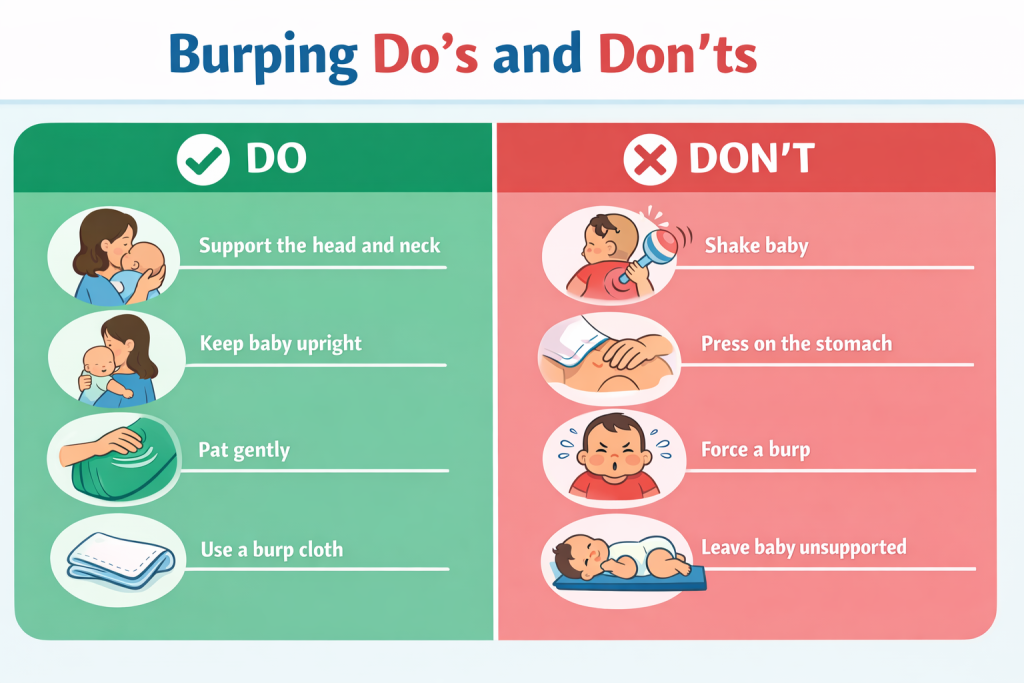
Learning how to burp newborn is really about reading your baby, not following a script like a robot. Support the head and neck. Keep the body fairly upright. Pat or rub gently. Try a couple of minutes, then move on if nothing happens. And remember: a calm baby who did not burp is not automatically a problem.
You do not need perfect technique. You need a gentle hand, a little patience, and enough confidence to tell the difference between “normal newborn weirdness” and “this needs a doctor.” You’ve got more instinct than you think.