What You Need To Know About Baby Sleep Regressions

We may earn a commission for purchases made using our links. Please see our disclosure to learn more.
Just when your baby begins sleeping in longer, more predictable stretches, bedtime can suddenly unravel. Naps shorten, night wakings multiply, and the soothing trick that worked last week may now be greeted with impressive outrage. Baby Sleep Regressions can feel like lost progress, but they are usually temporary changes connected with development, shifting sleep patterns, discomfort, or routine disruptions. This guide explains what regressions are, when they commonly appear, how to distinguish them from illness or hunger, and what you can do without turning every evening into a complicated sleep experiment. You will also find practical product recommendations, safe-sleep reminders, research-backed context, and realistic answers to the questions tired parents ask most.
Affiliate disclosure: This article may contain affiliate recommendations. If you buy through a qualifying link, the website may earn a commission at no extra cost to you.
What Are Baby Sleep Regressions?
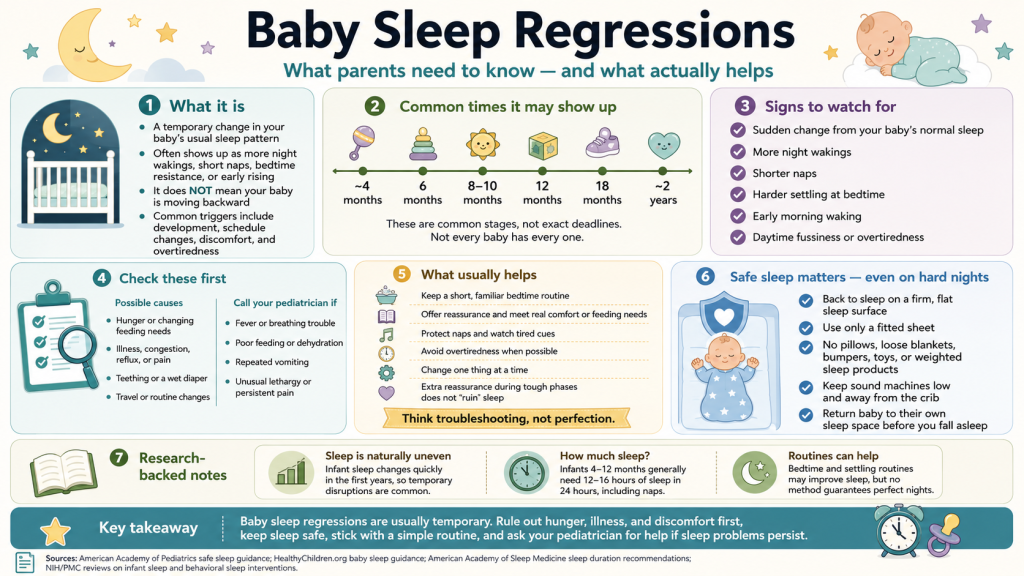
A sleep regression is a noticeable period when a baby who had been sleeping relatively well begins waking more often, resisting naps, taking longer to settle, or rising unusually early. The word “regression” is misleading because your baby is not necessarily moving backward. Often, sleep organization is changing while the brain and body learn new skills.
It is a descriptive parenting term, not a diagnosis. One baby may wake twice instead of once; another may suddenly treat 3 a.m. like social hour. What matters is a meaningful change from your baby’s usual pattern.
Why Baby Sleep Regressions Happen
Infant sleep changes rapidly during the first two years. As sleep cycles mature, babies may briefly surface between cycles. New motor skills, language development, separation awareness, travel, nap transitions, teething, growth, and illness can also disturb familiar rhythms.
Several causes may overlap. A baby learning to crawl might refuse a nap, become overtired, and need extra reassurance overnight. Because development varies, regression calendars are rough guides rather than appointments your child forgot to cancel.

Common Ages and Developmental Changes
Around 4 months, 6 months, 8 to 10 months, 12 months, 18 months, and around age 2, parents frequently report disturbances. These periods may coincide with maturing sleep cycles, mobility, separation anxiety, teething, language growth, or nap changes. Not every baby experiences each stage.
The four-month shift is often noticeable because sleep cycles are becoming more organized. Later disruptions may reflect new skills or schedules. Look at daytime behavior and recent changes rather than age alone.
Signs Your Baby May Be in a Sleep Regression
The clearest sign is a sudden departure from your baby’s normal sleep. You may see more night wakings, short naps, bedtime protests, early rising, daytime fussiness, or a stronger need for rocking, feeding, or your presence.
Track sleep, feeds, symptoms, and major changes for several days before overhauling the schedule. A simple phone note is enough. Patterns may reveal a drifting bedtime, a nap transition, discomfort, or a developmental burst.
Rule Out Hunger, Illness, and Discomfort First
Not every difficult week is a sleep regression. Hunger, congestion, teething, constipation, reflux symptoms, temperature, wet diapers, or an ear infection can disturb sleep. So can travel, a noisy room, or a changed caregiver.
Contact your pediatrician when sleep changes accompany fever, breathing difficulty, poor feeding, repeated vomiting, unusual lethargy, fewer wet diapers, persistent pain, or behavior that worries you. Pauses in breathing, blue or gray coloring, or difficulty waking need prompt medical attention.
What Is the Duration of a Sleep Regression?
Many temporary disruptions improve within several days to a few weeks, but there is no dependable countdown. Duration depends on the cause, temperament, health, schedule, and how quickly your baby adapts. Some changes, such as dropping a nap or developing mature sleep cycles, create a new pattern rather than restoring the old one.
Ask for professional guidance if poor sleep persists, worsens, affects feeding or growth, or leaves caregivers too exhausted to function safely.
How to Respond Without Rebuilding Everything
Begin with the smallest useful response. Keep familiar bedtime cues, offer reassurance, and meet genuine feeding or comfort needs. Avoid adding several new soothing habits in one exhausted night unless you are willing to maintain them.
Your response may include a brief pause, in-crib soothing, a cuddle, or gradually reducing assistance. Young infants still need responsive care and may require night feeds. Discuss formal sleep training with your pediatrician, especially for premature babies or children with health concerns.
Build a Bedtime Routine That Survives Change
A short bedtime routine gives your baby recognizable cues when sleep feels unpredictable. Try feeding, a clean diaper, pajamas or a fitted sleep sack, dim lights, and a quiet book or song before placing your baby on a safe sleep surface. It should calm, not become a 14-step production.
Keep the sequence similar while allowing flexibility. During a regression, protect the routine more than the exact clock time. If your baby is clearly exhausted, an earlier bedtime may help.
Handle Naps and Overtiredness Carefully
Poor naps can create a loop: your baby becomes overtired, struggles at bedtime, wakes more, and starts the next day behind. Offer naps at appropriate times and watch for tired cues such as yawning, staring away, eye rubbing, or sudden fussiness.
Temporary assisted naps may protect daytime sleep, but the supervising adult must remain awake and maintain safe positioning. If naps stay difficult, reassess wake periods or the number of naps. Change one variable at a time.
Feeding, Teething, and Separation Anxiety
Growth and daytime distraction can change feeding patterns. Offer calm, complete daytime feeds, but do not remove night feeds simply because a generic schedule says your baby “should” sleep through. Needs vary, especially for younger, premature, or medically complex babies.
Ask your pediatrician about safe teething relief. For separation anxiety, predictable goodbyes, peekaboo, and warm but consistent bedtime responses can help. Extra reassurance during this stage does not permanently ruin independent sleep.
Keep Sleep Safe During Rough Nights
Fatigue can tempt families toward unsafe shortcuts. Place your baby on their back on a firm, flat infant sleep surface with only a fitted sheet. Keep pillows, loose blankets, positioners, bumpers, toys, and weighted sleep products out. Room-sharing is safer than bed-sharing during infancy.
Return your baby to their own sleep space before you fall asleep, and avoid couches or armchairs when drowsy. Keep sound machines away from the crib at a low volume; some can produce hazardous output when loud and close.
Recommended Products for Baby Sleep Regressions
Products cannot cure Baby Sleep Regressions, but the right tool may make routines more consistent, travel less disruptive, or monitoring more convenient.
| Product | Best fit | Main trade-off |
| Hatch Baby Sound Machine | Custom routines | App-connected features |
| Yogasleep Hushh | Travel | Only three sound choices |
| Woolino Sleep Sack | Wearable warmth | Premium upfront cost |
| VTech VM819 | App-free monitoring | Smaller display |
| Tommee Tippee Blind | Daylight blocking | Requires suitable glass |
| Nanit Pro + Flex Stand | Smart monitoring | Higher cost and Wi-Fi reliance |
Hatch Baby Sound Machine, Night Light
Best for: Customizable bedtime cues
This sound machine and night light creates repeatable bedtime cues and allows settings to change as routines evolve. It suits parents wanting one nursery device that can continue into toddlerhood. Its flexibility is useful, although app-connected controls may feel overly complicated if you only need basic white noise.
Yogasleep Hushh Portable White Noise Sound Machine for Baby
Best for: Travel and stroller naps
The rechargeable Hushh provides three sounds, adjustable volume, a flexible clip, a night light, and a child lock. It moves easily between home, childcare, and travel. Its limited sound library keeps operation simple, but families wanting schedules, lullabies, or app control will need a fuller-featured machine.
Woolino 4 Season Ultimate Baby Sleep Sack – Merino Wool Baby Sleeping Bag, Organic Cotton Outer, Adjustable 2–24 Months Size
Best for: Changing room temperatures
This wearable blanket combines a merino-wool lining, organic-cotton outer, and sizing for roughly 2 months to 2 years. The broad fit may reduce repeated replacements as your baby grows. It costs more upfront and still requires correct sizing, suitable clothing underneath, and regular overheating checks.
VTech VM819 Baby Monitor No WiFi – 19Hr Video Battery, 1000ft Range, Night Vision, Two-Way Talk, Temperature Sensor, Sound-Activated Screen, Lullabies
Best for: Straightforward monitoring without Wi-Fi
The VM819 has a dedicated 2.8-inch display, lullabies, a temperature sensor, two-way communication, night vision, and a claimed 1,000-foot range. It avoids apps and home-network dependence. Its screen is smaller than many premium monitors, but the straightforward setup suits families wanting basic video and audio.
Tommee Tippee Sleeptight Portable Blackout Blind, Medium, 99 x 130 cm, Star and Moon Print
Best for: Bright rooms and travel
This adjustable blind uses suction cups and folds into a travel bag, helping darken unfamiliar rooms or nurseries during long summer evenings. Measure the window first, follow the manufacturer’s glass-safety instructions, and check the suction cups regularly. It will not suit every window shape or damaged glass.
Nanit Pro Smart Baby Monitor & Flex Stand – 1080p Wi-Fi Video Camera, 2-Way Audio, Sound/Motion/Cry Notifications, Night Vision, and Breathing Band
Best for: App-based monitoring at home and away
This Wi-Fi monitor has alerts, 1080p video, night vision, two-way audio, and a portable Flex Stand that lets you see in all directions. It suits families prioritizing remote access and app features. The trade-offs are cost, Wi-Fi reliance, and limited sleep analytics on the Flex Stand compared with an overhead mount.
What Research Says About Infant Sleep and Regressions
Research supports uneven infant sleep development, not a precise regression calendar. A review of infant sleep, cognition, and growth describes circadian development beginning in early infancy, while HealthyChildren guidance explains that regular sleep cycles emerge over the first months.
The American Academy of Sleep Medicine recommendation advises 12 to 16 hours of sleep for infants ages 4 to 12 months, including naps. A systematic review found that bedtime and settling strategies can improve outcomes, but results vary. Routines may help; no method guarantees uninterrupted nights.
Frequently Asked Questions About Baby Sleep Regressions
Can a sleep regression happen earlier or later than expected?
Yes. Commonly listed ages are broad observations, not biological deadlines. Development, illness, travel, feeding changes, temperament, and nap transitions can shift timing. Focus on how sleep differs from your baby’s usual pattern and what else is happening. A baby may also skip a widely discussed regression entirely.
Should I feed my baby during a sleep regression?
Feed your baby when hunger is likely, especially if they are young, growing rapidly, distracted during daytime feeds, or still expected to eat overnight. Do not remove feeds solely to match a generic schedule. Your pediatrician can advise based on age, growth, health, and feeding history.
Do Baby Sleep Regressions ruin sleep training?
Usually not. A regression may temporarily increase waking or the support your baby needs, but it does not erase learned sleep skills. Keep familiar cues and use a response you can apply consistently. Pause or modify formal sleep training when your baby is ill, in pain, or feeding poorly.
Is white noise safe for a baby?
White noise can mask household sounds, but volume and placement matter. Keep the machine away from the crib, use the lowest effective setting, and avoid maximum volume near your baby’s head. A phone decibel app offers only a rough estimate and is not a calibrated medical instrument.
When should I speak with a pediatrician?
Call when sleep changes accompany breathing problems, fever, poor feeding, dehydration, repeated vomiting, significant pain, unusual sleepiness, or developmental concerns. Also seek guidance when disrupted sleep persists, worsens, or creates unsafe caregiver exhaustion. A clinician can check for infection, reflux, breathing disorders, or another medical cause.
A Practical Way Forward Through Baby Sleep Regressions
Baby Sleep Regressions are easier to manage when you treat them as a troubleshooting period, not a parenting exam. Rule out hunger, illness, discomfort, and schedule mismatch first. Then protect safe sleep, preserve a short bedtime routine, and change only what genuinely needs changing. A Yogasleep Hushh can maintain familiar cues while traveling, while the VTech VM819 offers simple app-free monitoring. Technology adds convenience, not a cure. Your baby may need extra help for a while, and that is not failure. Share the load when possible, watch for warning signs, and contact your pediatrician when the disruption persists or your instincts say this is more than a temporary phase.