How To Build a Simple Sleep Log For Babies That Works

We may earn a commission for purchases made using our links. Please see our disclosure to learn more.
When baby sleep feels unpredictable, memory gets unreliable fast. After a few broken nights, it can be hard to remember whether a nap lasted 25 minutes or an hour, when the last feed happened, or whether bedtime has gradually shifted later. A Sleep Log For Babies gives you a clearer picture without turning parenthood into a data project.
The goal is simple: record enough information to spot patterns in naps, night sleep, wake-ups, and routines. This guide explains what to track, what to leave out, how long to keep a log, how to interpret it, and which tools can make tracking easier. You will also learn when your notes may be useful to share with a pediatrician.
What a Sleep Log For Babies Should Actually Track
A useful log answers a few practical questions: When did your baby fall asleep? When did they wake? How long was the sleep period? What happened shortly before sleep?
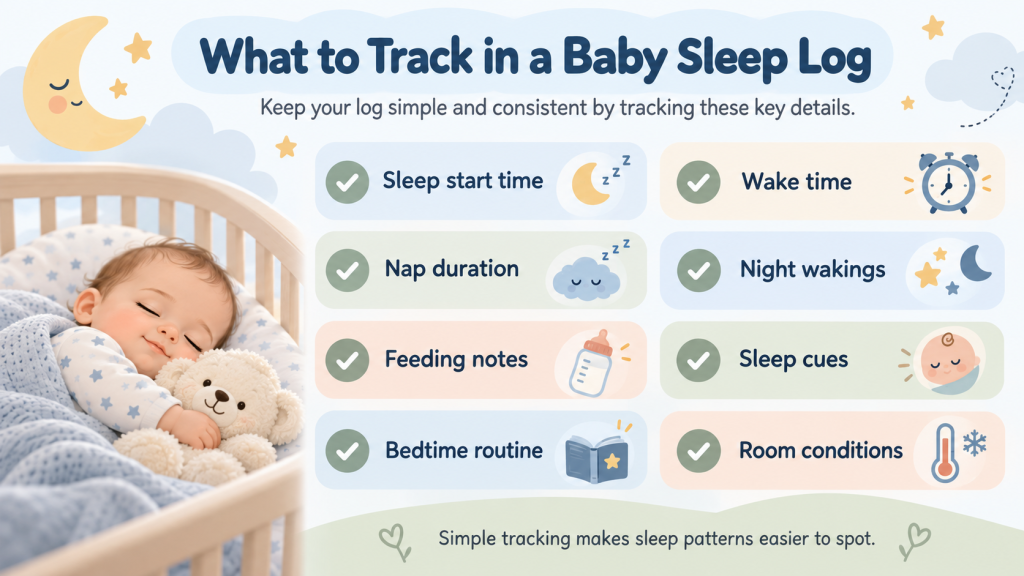
Start with five fields: sleep start time, wake time, nap or nighttime sleep, meaningful night wakings, and a short note. That note might say “fed before nap,” “fussy,” “car nap,” or “usual bedtime routine.”
For very young babies, feeding and diaper information may also provide useful context. However, keep the record simple enough that you can understand the entire day at a glance.
Start With a Simple 24-Hour Format
One page or screen per 24-hour period is usually easiest. This keeps overnight sleep connected to the naps and awake periods that came before it.
Write the date at the top and record sleep periods in chronological order. At the bottom, you can total daytime sleep and, if useful, total sleep across the full day.
Do not worry about precise calculations during a middle-of-the-night feeding. Write a rough time and tidy the entry later.
Consistency matters far more than creating a perfect spreadsheet. If your system is too complicated to use while tired, simplify it.
How to Record Naps Without Overcomplicating It
For each nap, record when your baby actually falls asleep rather than when the nap routine begins. Then record the wake time and approximate duration.
Include naps that happen in the car, stroller, or carrier. Even short periods of sleep may affect the rest of the day, and leaving them out can make later patterns harder to understand.
You can also note where the nap happened, but keep this optional. A Sleep Log For Babies should help you notice patterns rather than give you another long list of chores.
If you are unsure whether a five-minute doze counts, record it briefly and move on.
Track Night Sleep and Wakings Consistently
For nighttime sleep, record bedtime, morning wake time, and wakes that are noticeable enough to require feeding, soothing, or another response.
There is usually no reason to document every brief movement or sound. Instead, choose a consistent definition of a night waking and use it throughout your tracking period.
For example, you might count a waking only when your baby clearly wakes and needs your attention.
Fragmented sleep is normal for newborns. The American Academy of Pediatrics notes that newborns may sleep around 16 to 17 hours daily while sleeping for only one or two hours at a time.
Add Feeding and Diaper Notes Only When Useful
A sleep log can quickly become overwhelming if it tries to document every part of baby care.
Record feeding when it adds context, such as “full feed before bed,” “woke hungry,” or “fed during 3 a.m. waking.” Diaper information can also be included when you are already monitoring output or following medical guidance.
Otherwise, keep those details separate.
Ask yourself whether the information will help explain the sleep pattern when you review the log later. If the answer is no, it is likely something you can do without.
A simple log maintained consistently is far more useful than a complicated one abandoned after two days.
Record Sleep Cues, Mood, and Bedtime Routine
Times tell you what happened. A small amount of context may tell you why.
Add a word or two describing how your baby seemed before sleep: calm, alert, yawning, fussy, rubbing eyes, or crying. After several days, repeated patterns may become easier to see.
If tiredness is difficult to read, this guide to recognizing baby sleep cues explains common early and later signs without treating every cue as a strict rule.
You can also record whether your usual bedtime routine happened. “Bath, feed, song” provides plenty of information without creating more work.
How Long Should You Keep a Sleep Log For Babies?
Seven to fourteen days is a practical starting point for finding patterns. One difficult night tells you very little, while a week can reveal whether certain behaviors keep repeating.
You may want to track longer during a gradual schedule adjustment or before discussing ongoing sleep concerns with a pediatrician.
However, you do not need to record sleep indefinitely. Once you understand your baby’s current pattern and the log stops providing useful information, set it aside.
You can always restart it after travel, illness, a nap transition, or another noticeable change in sleep.
How to Read Patterns Without Chasing Perfection
Review several days together rather than judging individual naps.
Look for simple relationships. Are naps occurring around similar times? Do difficult bedtimes repeatedly follow late afternoon naps? Are night wakings clustering around roughly the same time?
These observations provide clues, not formulas.
Babies change rapidly, and something that appears consistent this week may shift next month. Therefore, avoid turning averages into rigid rules or treating a difficult day as evidence that something has gone wrong.
Your log describes what your baby is currently doing. That is its value.
Research-Backed Guidance for Baby Sleep Tracking
Sleep diaries are useful observations, but they are not objective medical measurements. A 2015 study comparing infant sleep diaries with actigraphy found differences between the two methods, especially when measuring night waking. Use your diary to organize what you observe rather than treating each entry as laboratory-level data. Read the infant sleep diary and actigraphy study PubMed Central (PMC)
For babies ages 4 to 12 months, the American Academy of Sleep Medicine recommends 12 to 16 hours of sleep within 24 hours, including naps. Its 2016 consensus followed a review of 864 published articles. See the AASM pediatric sleep-duration consensus PubMed Central (PMC)
Bedtime routines can matter too. A 2009 randomized study involving 405 families with children ages 7 to 36 months found improvements in several sleep measures after introducing a consistent nightly routine. Because the youngest participants were seven months old, the findings should not automatically be extended to newborns. Review the bedtime-routine study PubMed
Recommended Products for a Sleep Log For Babies
You can create an effective log with an ordinary notebook. However, these tools may make tracking or maintaining consistent sleep conditions easier.
Pearhead Baby’s Daily Log Book, Nursing, Sleep, Feeding, Diapers, Pumping
Best for: Parents who prefer paper tracking
This undated book provides dedicated sections for sleep, feeding, diaper changes, and daily notes across 50 double-sided pages. The structured layout works well for parents who want one physical record that caregivers can share. Its broader baby-care format may provide more sections than you need if you only want to track sleep.
Hatch Rest Baby Sound Machine, Night Light, 2nd Gen
Best for: Families building a repeatable bedtime routine
The Rest 2nd Gen combines sound, adjustable light, app control, and programmable bedtime and wake routines. It is particularly useful when you want to record whether consistent environmental cues were used each evening. Some additional content requires a subscription, so families wanting only basic sound and light functions should consider that first.
Yogasleep Hushh Portable White Noise Sound Machine for Baby
Best for: Travel and naps away from home
The Hushh provides three sound options, adjustable volume, rechargeable power, a child lock, and a compact clip-on design. Its portability makes it useful when you want to maintain one familiar sleep cue away from home. It does not track sleep, so you will still need a notebook or digital log.
Dreambaby Crocodile Bath & Room Thermometer
Best for: Parents tracking room conditions
This digital thermometer measures both room and bath-water temperature and refreshes readings every 10 seconds while operating. That makes it easy to add environmental context to occasional sleep-log entries. It automatically switches off after 30 minutes, however, so it is not designed as a continuous overnight temperature monitor.
Munchkin Shhh Portable Soothing Sound and Light Machine
Best for: A simple battery-powered sleep cue
This portable device offers shushing, heartbeat, and white-noise sounds, along with a night light and timer. It suits families wanting a straightforward option for home or travel without app setup. Because it uses AA batteries and has fewer customization options than larger machines, its main advantage is simplicity.
Paper vs Digital Sleep Tracking: Which Is Better?
Paper wins on simplicity. A notebook beside the changing table can be easier at 3 a.m. than opening an app, and multiple caregivers can understand it immediately.
Digital tools make automatic totals, trends, shared records, and historical searches easier. On the other hand, detailed apps sometimes encourage parents to monitor every minute.
Choose whichever format you will consistently use.
A paper Sleep Log For Babies is perfectly capable of showing nap and waking patterns. Digital tracking becomes more attractive when several caregivers need synchronized information or you value automatic calculations.
Common Sleep-Log Mistakes to Avoid
The biggest mistake is tracking too much. Twenty required fields can quickly turn a useful habit into homework.
Another problem is changing definitions halfway through. Decide what counts as asleep, a nap, or a meaningful night waking and stay reasonably consistent.
Avoid searching for a perfect schedule after only one or two days as well. Temporary changes are normal.
Finally, do not use your log to compare your baby with another child. Age-based sleep guidance provides useful context, but individual sleep needs and patterns vary.
If tracking starts increasing stress without helping you make decisions, simplify the log or stop for a while.
When a Sleep Log Is Worth Sharing With a Pediatrician
A sleep record can be particularly helpful when a concern is persistent or difficult to describe.
Instead of saying, “My baby barely sleeps,” you can show approximate nap lengths, bedtime, nighttime waking patterns, feeding notes, and how long the change has been happening.
However, neither a sleep diary nor a consumer tracking device should be used to diagnose a medical condition.
If your baby has breathing difficulty, turns blue or gray, is unusually difficult to wake, or you believe something is urgently wrong, seek medical attention rather than waiting to gather more sleep data.
Sleep Log For Babies FAQ
What should I include in a Sleep Log For Babies?
Record sleep start time, wake time, naps, nighttime sleep, meaningful wakings, and one short context note. Add feeding, diaper, room-temperature, or routine information only when it helps explain what happened. Keeping the log simple makes consistent tracking much easier.
How many days should I track my baby’s sleep?
Seven to fourteen days is a useful starting period for finding repeated patterns. You may track longer during a schedule change or before a pediatric appointment. If illness, travel, or another temporary disruption occurs, note it so those days are not mistaken for your baby’s usual sleep pattern.
Should I track wake windows too?
You can, although separate wake-window calculations are unnecessary if you already record every sleep and wake time. The awake periods between those entries are visible automatically. This keeps your daily tracking simpler while still giving you enough information to review awake periods later.
Is a baby sleep log accurate?
A log can accurately document what a caregiver observes, but it is not the same as objective sleep measurement. Research comparing infant diaries with actigraphy found differences, particularly around nighttime waking. Use your record for pattern recognition and communication rather than diagnosing sleep problems.
Can a sleep log help fix short naps or night wakings?
It can reveal patterns connected with short naps or repeated wakings, including timing, late naps, feeding, and routine changes. However, logging itself does not solve sleep difficulties. Its job is to make recurring patterns easier to see so you can make more informed adjustments.
Final Recommendation: Keep Your Sleep Log For Babies Simple
A Sleep Log For Babies works best when it is quick enough to maintain but detailed enough to answer useful questions. Start with sleep and wake times, then add only the context that helps explain what you see. Review several days together rather than reacting to one difficult nap or night.
For paper tracking, the Pearhead Baby’s Daily Log Book offers ready-made structure. If consistent bedtime cues are harder to maintain, Hatch Rest 2nd Gen provides sound and light routines that can be repeated while you track the results.
Whatever format you choose, treat the log as an observation tool rather than a scorecard. Start with one week, look for repeated patterns, and keep only the information that genuinely helps your family.