Newborn That Won’t Sleep? Common Causes and Gentle Ways to Help

We may earn a commission for purchases made using our links. Please see our disclosure to learn more.
You have fed your baby, changed the diaper, and rocked for what feels like forever. Yet your newborn wakes the moment you put them down. Dealing with a newborn that won’t sleep can leave you wondering whether something is wrong, especially when everyone seems to have a different solution.
Newborn sleep is naturally irregular. Their bodies are still learning night from day. Still, hunger, discomfort, stimulation, or an unsuitable sleep environment can make an already difficult night harder. This guide explains what is normal, how to settle your baby gently, which products may genuinely help, and the warning signs that deserve medical attention. The aim is safer, more manageable sleep, not a perfect schedule.
Why a Newborn That Won’t Sleep May Be Acting Normally
Newborns often sleep around 16 to 17 hours across a day, but that sleep can arrive in stretches lasting only an hour or two. Repeated waking does not necessarily mean insufficient sleep.
Their sleep cycles are immature, and active sleep can look surprisingly noisy. Grunting and twitching do not always mean your baby is awake. Pause long enough to see whether their eyes open and they need help, while responding promptly to real crying or feeding cues.
Check Basic Needs Before Trying Sleep Tricks
Start with the simple possibilities. Is your baby hungry, wet, too warm, too cold, or uncomfortable in their clothing? Check whether a burp is needed and whether their nose seems blocked. Look for any hair that may be tightly wrapped around a finger or toe.
Address one likely problem at a time instead of cycling through ten soothing techniques. A fresh diaper or quiet feed may solve the problem. If your baby stays unsettled, move on to calming rather than assuming they need to be kept awake longer.

Hunger, Cluster Feeding, and Frequent Night Waking
Newborns have small stomachs and need feeds throughout the night. During cluster feeding, especially in the evening, a baby may ask to eat again soon after finishing. That does not automatically indicate a feeding problem.
Watch for rooting, hands moving toward the mouth, and searching movements before intense crying begins. Follow your clinician’s feeding guidance, particularly if your baby is premature, jaundiced, or still regaining birth weight. Never stretch feeds simply to encourage longer sleep. Ask for support if feeds seem ineffective or painful.
Recognize Sleepy Cues Without Following a Strict Clock
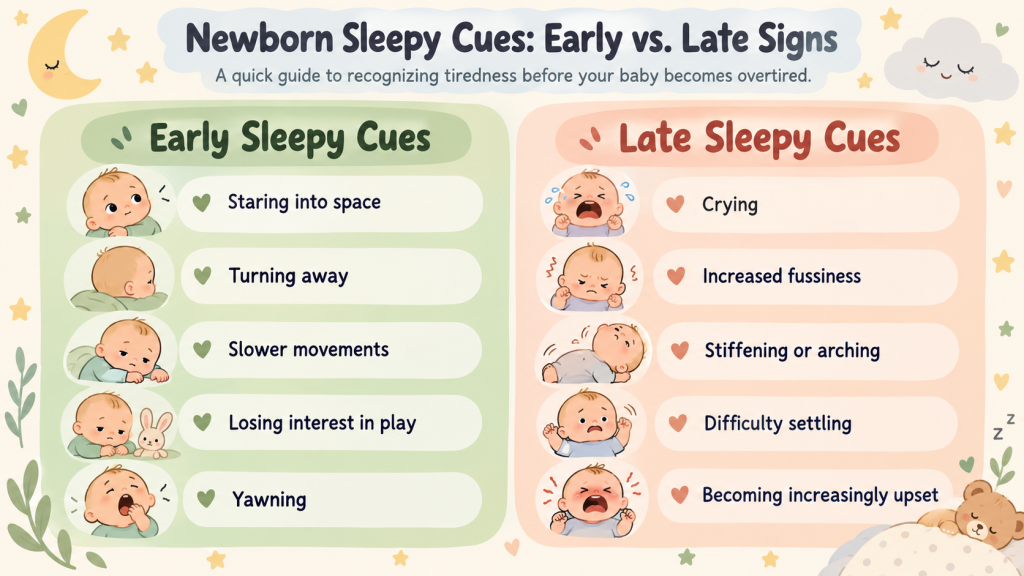
A newborn who seems alert may actually be getting tired. Look for staring into space, turning away, slower movements, yawning, or losing interest in faces. Fussing and stiffness may appear later.
Wake-window charts can offer a loose reference, but they are not medical rules. Watch your baby alongside the clock, and begin settling when several early cues appear rather than waiting for a dramatic yawn or full-blown crying.
For more detail on subtle and obvious signs, see our guide to baby sleep cues.
How to Calm a Newborn Who Fights Sleep
First, lower the stimulation: dim the room, reduce conversation, and put away bright screens. Hold your baby close, support the head and neck, and try slow rocking, gentle patting, or quiet singing. Repetition often works better than switching methods every few seconds.
If movement upsets them, try still contact. Some need feeding; others need cuddling. There is no guaranteed instant fix, and comfort is appropriate for a newborn. Once your baby is ready for sleep, lay them on their back in their own safe sleeping area.
Help Your Baby Learn the Difference Between Day and Night
Daylight and normal household activity can help establish a contrast with nighttime. Open the curtains during daytime feeds and play, then use a quieter voice and softer lighting for nighttime care. Naps do not require silence.
Keep evening routines short: perhaps a feed, clean diaper, sleep clothes, cuddle, and lullaby. Repeat the sequence when practical rather than insisting on an exact bedtime. Treat the routine as a familiar signal, not a sleep guarantee.

Create a Safe Sleep Space Every Time
The safest setup is a safety-compliant crib, bassinet, or play yard with a firm, flat, non-inclined mattress and fitted sheet. Place your baby on their back for sleep, and keep the sleep space free of pillows, toys, loose bedding, bumpers, loungers, and positioning wedges.
Keep your baby in the same room but in a separate sleep space, ideally for at least the first six months. Keep cords and curtains beyond reach. Dress your baby appropriately without overheating. Move babies sleeping in swings or sitting devices to flat sleep surfaces promptly.
Swaddling, Pacifiers, and Gentle Comfort Tools
Some young babies settle when safely swaddled because it limits sudden arm movements. Choose a properly fitting, non-weighted swaddle with room for hip movement. Stop swaddling once your baby begins showing signs of trying to roll, and consider switching to a regular arms-free sleep sack afterward.
You can offer a pacifier at sleep time, never instead of a feed. If you are breastfeeding, wait until nursing is well established. Do not attach strings or clips during sleep, and do not force a pacifier on a baby who refuses it.
What Can You Do If Your Newborn Will Only Sleep When Being Held?
Wanting contact is common, but falling asleep together on a sofa or recliner is dangerous. If you feel sleepy, put your baby in their separate, safe sleep space rather than continuing a contact nap. Ask an alert adult for help.
To practice transfers, settle your baby, then lower them gently onto their back in the bassinet. Keep your hands nearby briefly if that helps, without adding objects to the mattress. Try again later instead of forcing independent sleep.
Gas, Spit-Up, and Stuffy Noses at Bedtime
Discomfort can interrupt sleep, particularly after feeds. Burp gently as needed. If spit-up worries you, remember that back sleeping remains the recommended position even for babies with uncomplicated reflux. Do not elevate the mattress or use a sleep wedge.
For nasal congestion, plain saline drops and gentle suction may help before feeding or rest. Use nasal aspirators sparingly and follow directions. Breathing difficulty, persistent vomiting, or poor feeding deserves medical advice, not another sleep gadget.
When a Newborn’s Poor Sleep Needs Medical Attention
Contact your pediatrician if your baby feeds poorly, has noticeably fewer wet diapers, cries inconsolably, or suddenly sleeps very differently from usual. For babies three months old or younger, a rectal temperature of 100.4°F (38°C) or above should be evaluated by a medical professional right away, even if no other symptoms are present.
Seek emergency help if your baby has trouble breathing, turns blue or gray, is limp, or is very difficult to wake. Inability to wake for feeds also needs evaluation. Never delay care for sleep advice.
Recommended Products for a Newborn That Won’t Sleep
Products cannot replace feeding, responsive comforting, or safe sleep, but a few targeted tools can solve specific problems. Choose based on your baby’s needs.
HALO 100% Cotton Sleepsack Swaddle, 3-Way Adjustable Wearable Blanket, TOG 1.5, Midnight Moons Grey, Newborn, 0–3 Months
Best for: Parents who want an adjustable newborn swaddle
This cotton swaddle has adjustable wings, three arm-position options, and a zipper that makes diaper changes easier. It replaces loose bedding. Check the warmth rating against room conditions, and stop using swaddling configurations immediately when your baby shows signs of trying to roll.
Philips Avent Soothie Baby Pacifier for 0–3 Months, BPA-Free, 4-Pack, Green, SCF190/41
Best for: Babies who find sucking comforting
Designed for the newborn stage, these one-piece silicone pacifiers have a symmetrical nipple and can be cleaned according to the manufacturer’s directions. They may help during settling once feeding needs have been met. Some babies will not accept a pacifier, and it must never be attached to a cord, clip, or stuffed toy during sleep.
Yogasleep Dohm UNO White Noise Machine with Real Fan Inside
Best for: Families wanting a simple, non-app sound option
The Dohm UNO produces a continuous fan-based sound and lets you adjust its tone without selecting digital tracks. It softens unpredictable household noise. It requires a power outlet; keep the device and cord away from the crib, and use the lowest helpful volume rather than turning it up to mask every sound.
NICETOWN Black Blackout Curtains for Bedroom, 42 x 63 Inches, 2 Panels
Best for: Bedrooms with distracting daylight
These polyester grommet curtains are designed to darken windows and come as two 42-by-63-inch panels. They reduce light during daytime naps. They are room-darkening rather than a guaranteed total blackout solution, and the hardware and hanging fabric must stay securely installed and well beyond your baby’s reach.
Frida Baby NoseFrida SnotSucker Nasal Aspirator for Baby, 4 Hygiene Filters
Best for: Occasional stuffy-nose discomfort
This manual aspirator uses a tube, mouthpiece, and disposable hygiene filter to remove mucus without inserting a tip deeply into the nostril. Use with plain saline for troublesome congestion. It is not a routine sleep aid; clean the parts and replace filters as directed, and seek medical advice for breathing concerns.
Research-Backed Guidance on Newborn Sleep and Safety
The American Academy of Pediatrics’ 2022 safe-sleep policy recommends back sleeping, a firm non-inclined sleep surface, room-sharing without bed-sharing, and avoiding loose bedding and overheating. These measures reduce sleep-related risks, not guarantee longer sleep.
The AAP’s guidance on newborn sleep explains that frequent short sleep periods are developmentally typical. The NHS’s baby sleep guidance similarly emphasizes individual variation and gentle day-night routines.
Sound machines deserve caution. A 2014 study published in Pediatrics measured 14 infant sound machines and found that some could produce potentially harmful sound levels at maximum volume. Risk depends on distance, volume, and duration. Keep sound low and the speaker away from your baby.
Frequently Asked Questions About a Newborn That Won’t Sleep
Why does my newborn wake up as soon as I put them down?
The transfer may interrupt light sleep, or your baby may simply prefer contact and warmth. Try a calm transfer after settling, keeping the sleep space firm, flat, and empty. Avoid adding pillows, rolled towels, or positioners to recreate the feeling of being held. Failed transfers do not necessarily signal illness.
Is it normal for a newborn to stay awake for hours?
Occasional long awake periods happen, but repeated prolonged wakefulness alongside distress, poor feeding, or few wet diapers deserves discussion with your pediatrician. Look at sleep across the entire day rather than judging one stretch. Avoid rigid timetables and seek help for illness.
Should I wake my newborn to feed at night?
Sometimes, yes. Very young babies, especially those not yet back to birth weight or with specific medical or feeding concerns, may need scheduled waking. Follow your pediatrician’s recommendations instead of a generic sleep schedule. Your clinician can advise when longer stretches are appropriate.
Can white noise help a newborn fall asleep?
Steady sound may mask sudden background noises, but it will not solve hunger, pain, or illness. Choose a simple setting, keep the machine far from the sleep area, and use a low volume. Avoid assuming louder sound works better. A sound machine is optional.
When will my newborn start sleeping longer at night?
Many babies gradually develop longer nighttime stretches over the first several months, but there is no guaranteed age. Feeding requirements, growth, temperament, and illness all affect sleep. Focus on safe sleep, predictable nighttime cues, and responsive feeding now. Discuss unusual patterns with your pediatrician.
Final Thoughts: Helping a Newborn That Won’t Sleep
A newborn that won’t sleep is often a baby who needs feeding, comfort, help settling, or simply time for sleep rhythms to mature. Start by checking basic needs, watching early sleepy cues, and making daytime and nighttime feel different. Do not push for longer stretches by withholding feeds or using unsafe sleep arrangements.
A properly fitted HALO swaddle may help before rolling begins, while a Philips Avent Soothie could suit a baby who enjoys sucking. Neither is essential, and neither substitutes for responsive care. Choose other tools only for a specific need.
The most useful approach is a short, repeatable calming routine, a separate safe sleep space, and medical guidance whenever your baby’s behavior seems abnormal or concerning.