Crib Bumper Safety Guide for New Parents
We may earn a commission for purchases made using our links. Please see our disclosure to learn more.
You’re not alone if you’ve typed crib bumper into Google at 2:17 a.m. with one hand while the other hand is doing that gentle “pleaseee stay asleep” pat. The idea sounds so logical: my baby won’t bonk their head on the slats… and the crib will look cozier.
But crib safety is one of those parenting areas where “cozy” and “safe” don’t always overlap.
In this guide, I’ll walk you through what a crib bumper is, why so many parents still want one, what current safety guidance and U.S. rules say, and what to do instead—so you can feel confident about your baby’s sleep space.
Affiliate disclosure: This article includes a short Amazon alternatives section; as an Amazon Associate, I may earn from qualifying purchases.
Crib bumper 101: what it is and why it became popular
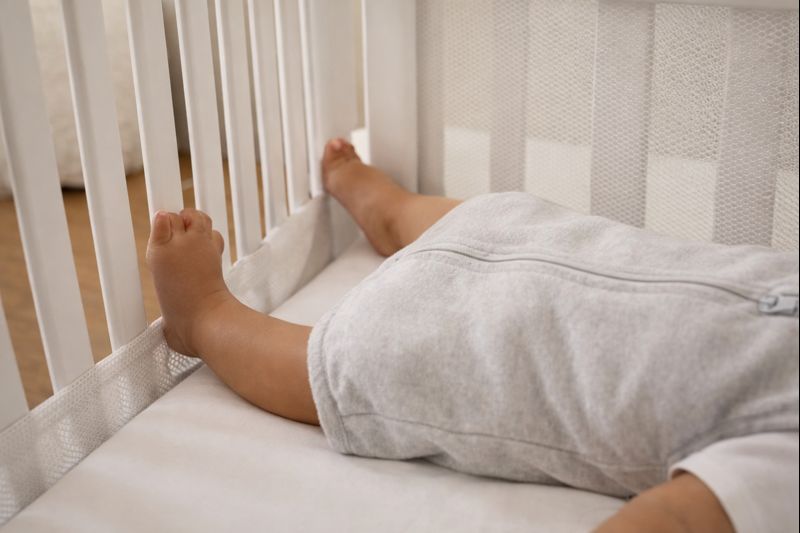
A crib bumper is anything designed to line the inside perimeter of a crib—usually to “cushion” the slats or prevent arms/legs from getting through. Traditional versions are padded fabric. Newer versions may look like vertical slat covers or “breathable” mesh-style liners.
Why people love the idea:
- It looks protective (like tiny crib padding)
- It feels “finished” (Pinterest-ready nurseries did a number on us)
- It seems like it would prevent bumps and stuck limbs
The tricky part is that what looks protective can introduce risks in a sleep space.
The safety bottom line: what experts say about crib bumpers
Here’s the heart of it: major safe-sleep guidance recommends keeping soft items out of the crib, and that includes crib bumpers. The CDC’s safe sleep guidance emphasizes a clear sleep surface—no loose bedding or soft objects near a baby’s face.
And it’s not only “best practice” advice—crib bumpers are banned from being sold or distributed in the U.S. under the Safe Sleep for Babies Act, with the ban effective November 12, 2022. The CPSC notes it’s unlawful to sell, offer for sale, manufacture, distribute, or import crib bumpers into the United States.
Why crib bumpers feel like a good idea (your “nesting brain” is loud)
I swear nesting is a real force. You look at a crib and your brain goes:
“Hard wood + gaps = danger. Add padding.”
That instinct makes sense… in a playroom. But sleep safety works more like a minimalist packing list: the fewer items, the fewer things that can go wrong.
A helpful analogy: adding soft padding to a crib can be like adding extra pillows to a car seat—comfort vibes, but not designed for safety.
The real risks: suffocation, entrapment, strangulation
This is the part nobody enjoys reading, but it matters.
Crib bumpers can increase risk through:
- Suffocation: a baby’s face can press into soft material
- Wedging/entrapment: baby can get stuck between bumper and mattress/crib side
- Strangulation/cord hazards: ties or loose fabric can create danger
The 2016 Journal of Pediatrics paper described mechanisms like suffocation and wedging, and found the public health “benefits” of bumpers weren’t supported by the available data.
🧪 Research-Backed: What studies and pediatric experts say about crib bumpers
If you’ve ever thought, “But a crib bumper would stop those slat bumps,” you’re thinking like a loving, protective parent. The problem is that real-world evidence doesn’t support crib bumpers as a safety upgrade.
A key study linked crib bumpers to suffocation and wedging (2016)
In a peer-reviewed analysis, Scheers, Woodard & Thach (2016) reviewed U.S. incident data and reported 48 suffocations connected to crib bumpers (many involving the bumper alone, not “extra clutter”), plus additional deaths involving wedging mechanisms. That’s why experts treat crib bumpers as a hazard—not a helpful cushion.
Read: Crib bumper deaths study (Scheers et al., 2016, The Journal of Pediatrics)
Pediatric safe-sleep guidance is clear: keep bumpers out (AAP)
The American Academy of Pediatrics (AAP) recommends a firm, flat sleep surface and keeping soft items—including crib bumpers—out of the sleep space. Their guidance is basically the “less stuff, safer sleep” rule, which can feel emotionally hard but is incredibly practical.
See: AAP safe sleep guidance on crib bumpers (updated 2025)
“My baby keeps bumping the slats”—what’s normal, what’s not
This is such a real worry. You hear that little thunk and your whole soul leaves your body.
A few reassuring truths:
- Small bumps happen as babies learn to roll, scoot, and reposition
- Most babies adjust quickly and don’t “keep hurting themselves”
- A firm crib mattress and a properly fitted sheet do more for safety than padding
If you’re seeing frequent face-first slat impacts, talk to your pediatrician—sometimes it’s about sleep positioning habits or developmental movement, not a “need” for bumpers.
Are breathable crib bumpers or mesh liners safer?
You’ll see terms like breathable crib liner, mesh crib bumper, and “airflow technology.” Marketing is very good at making things sound like they beat the laws of physics.
Important nuance from the CPSC: the legal definition of “crib bumper” does not include a non-padded mesh crib liner—but it does include padded bumpers, vinyl bumper guards, and vertical slat covers.
Still, many safe-sleep recommendations stay conservative: the safest setup remains a bare crib (firm mattress + fitted sheet only).
So if you’re asking, “Is mesh better?”—it may reduce some hazards compared with thick padding, but it’s not the gold standard of safe sleep.
What the U.S. law says now (and what that means for buying/selling)
If you’re in the U.S., this part is simple but surprising:
- The Safe Sleep for Babies Act makes crib bumpers “banned hazardous products.”
- The ban applies to selling, distributing, and importing—regardless of manufacture date.
- The CPSC lists the effective date as November 12, 2022 and points to the rule codification.
If you’re outside the U.S., rules vary—so the best move is to follow your local health authority plus widely accepted safe-sleep guidelines.
Safe sleep setup basics (the “bare crib” checklist)
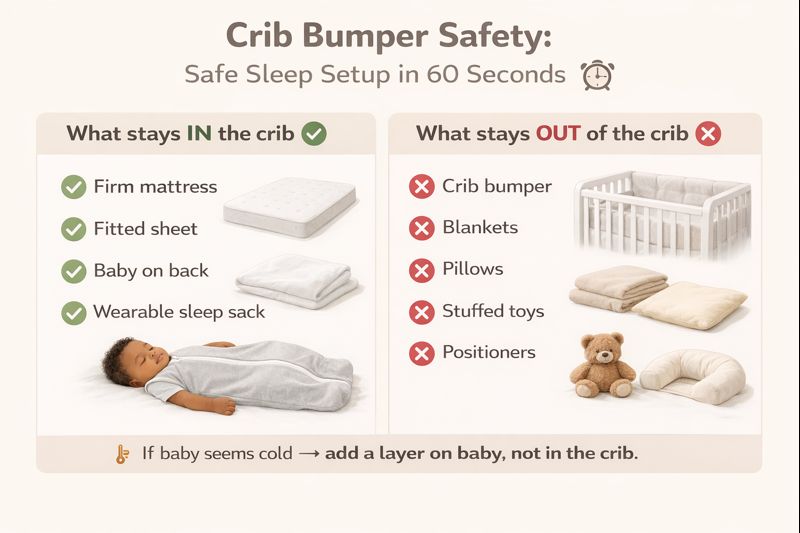
If you want the simplest “I can breathe now” checklist, here it is:
- Firm crib mattress
- Tight fitted sheet
- Baby on their back for sleep
- No pillows, quilts, stuffed animals, loose blankets
- No sleep positioners or wedges
- Crib meets modern safety standards (slat spacing, stable frame)
The CDC’s safe sleep guidance reinforces the value of a clear sleep space and room-sharing (not bed-sharing) for reducing risk.
Better ways to protect your baby from bumps—without bumpers
You’re not “overreacting” for wanting a softer world for your baby. You just need safer tools.
Try these instead:
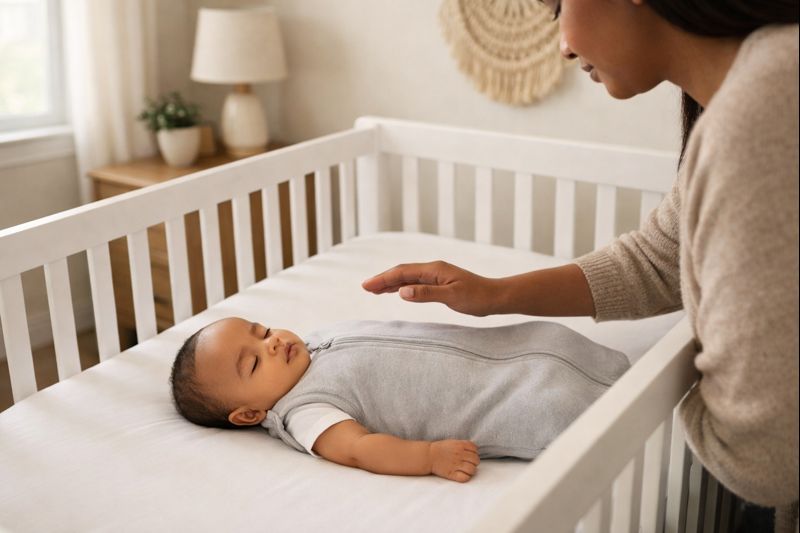
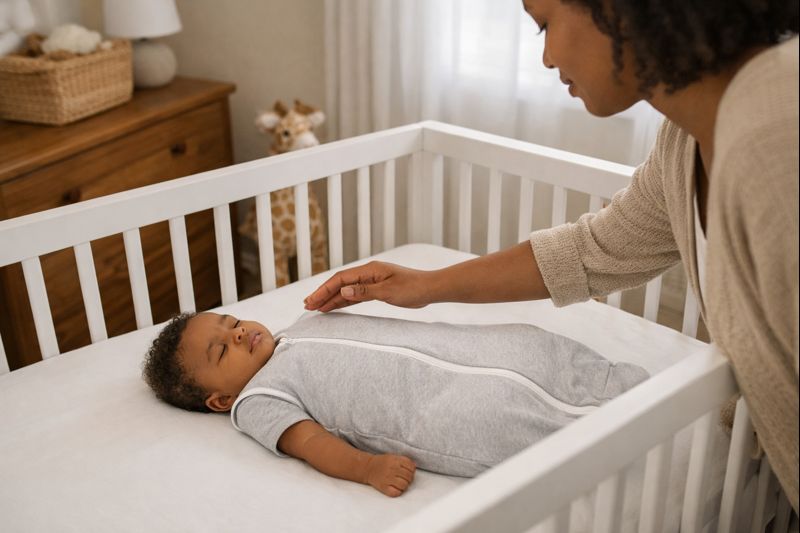
- Sleep sacks / wearable blankets (no loose fabric)
- Correct mattress fit (no gaps at the edges)
- Lowering the mattress as baby grows and pulls up
- Time (babies get better at repositioning)
And honestly? A lot of “stuck limb” stress fades once you realize most babies treat it like a weird little puzzle and then move on.
Warmth without blankets: dressing baby for sleep
This is where many parents reach for a crib bumper or extra bedding: you just want your baby warm, right?
The safer route is to dress for the room temperature using layers and a sleep sack instead of adding loose items to the crib.
If you want a practical guide to nighttime baby clothing (including how to think about layers), use this internal resource: what your baby should wear at night.
A quick, parent-to-parent rule of thumb
If you’re comfortable in a light layer, your baby usually does well in a onesie + sleep sack (adjust for your climate and your baby’s needs). When in doubt, check baby’s chest/back—not icy hands or feet (those can be cool even when baby’s fine).
If you already have a crib bumper at home
No shame. Most of us were gifted things by well-meaning family members who raised babies in a different era.
Here’s what to do:
- Don’t install it (even “just for naps”)
- If it’s already on the crib, remove it today
- Repurpose it safely (nursery decor out of reach, memory box, donation if legal where you live)
If you feel guilty because it was expensive: your baby’s safety doesn’t care about sunk costs. (Mine doesn’t either—my takeout budget can confirm.)
How to talk to family and caregivers who swear by bumpers
This can get emotional fast, especially with grandparents.
A script that keeps it calm:
- “We’re following current safe sleep guidelines.”
- “Crib bumpers are considered unsafe, and they’re banned for sale in the U.S.”
- “We’re using sleep sacks instead, so baby stays cozy without loose items.”
If someone says, “I used bumpers and you survived,” you can gently reply:
- “A lot has changed as we’ve learned more. I’m grateful you kept me safe—now we’re doing what’s recommended today.”
Quick shopping checklist for safer crib accessories
When you’re shopping, watch for “safety-sounding” language that’s really just marketing.
Look for:
- Snug fit (especially sheets and mattress protectors)
- No ties/cords that could end up near baby
- Breathable, washable materials (practical matters at 3 a.m.)
- No thick padding inside the sleep area
- Clear use case (if you can’t explain it in one sentence, skip it)
If it claims to “prevent SIDS” or “guarantee safety,” that’s your cue to back away slowly.
Product Picks: “Crib Bumper” Alternatives You’ll Actually See on Amazon (Mesh Liners)
Below are 5 options that match strong buyer intent (and have solid review volume on the listings I checked).
1) AirflowBaby Essential Mesh Crib Liner (White, 11″) – Full-Size (4FS)
Why parents like it: Simple, breathable, and “does the job” if your main issue is limbs getting caught.
Standout features
- Breathable mesh (no padding)
- Taller 11″ height coverage
- Adjustable fit for 3–4 sides on many full-size cribs
Best for
- Babies who keep “threading” their legs through slats at night
- Parents who want a straightforward, easy-to-install option
2) AirflowBaby Essential Mesh Crib Liner (Gray, 11″) – Full-Size
Why it’s a solid pick: Same idea as the White version, just a neutral color that hides scuffs a bit better (real-life parenting = messy).
Standout features
- Breathable mesh liner (no padding)
- 11″ height
- Strong review count shown on the related listing panel
Best for
- Nurseries where you want a softer, darker look
- Babies who get “stuck” legs and parents who are tired of replacing lost pacifiers
3) BreathableBaby Breathable Mesh Liner (Deluxe 4mm), Natural Linen — Full-Size (4FS)
If you want that “soft, neutral nursery” vibe without going padded, this deluxe 4mm mesh liner is a really solid pick—breathable, sturdy, and designed to help keep little arms/legs from slipping through slats.
Key features:
- Deluxe 4mm mesh with airflow-focused design
- Fits full-size cribs (52″ × 28″) and can cover 3 or 4 sides
- Hook-and-loop closure for easier install and adjustment
- Machine washable (because… babies)
Best for (use cases):
- Parents who want a crib-bumper look but prefer a breathable mesh liner style
4) BreathableBaby Classic Breathable Mesh Liner (Gray, 3mm) – Size 2FS (Covers 2 Sides)
Why this one exists: Some crib setups (solid ends, attached changing table, etc.) don’t need a full wrap. This “2 sides” version is made for that.
Standout features
- 3mm mesh (no padding)
- Designed specifically to cover 2 sides
- Review count shown on the related listing panel
Best for
- Cribs with 2 solid ends or setups where only the long sides are slatted
- Parents who want coverage only where it’s needed
5) BreathableBaby Classic Mesh Liner (Starlight pattern, 3mm) – Full-Size (4FS)
Why include a pattern option: Some parents really want a nursery vibe that feels intentional (and not like you panic-added baby gear at 2 a.m.). This gives you that… without going “cute but risky.”
Standout features
- 3mm mesh (no padding)
- Full-size 4FS fit style
- High rating volume shown on the BreathableBaby listing panels
Best for
- Parents who want a design-forward nursery but still prefer breathable mesh vs. padded “crib bumper” styles
Crib bumper FAQs (real questions parents actually ask)
Are crib bumpers safe for newborns?
No—safe-sleep guidance recommends keeping soft items out of the crib, and research has linked crib bumpers with suffocation and wedging risks.
Are crib bumpers illegal in the U.S.?
The CPSC explains that the Safe Sleep for Babies Act makes crib bumpers banned hazardous products, with the ban effective November 12, 2022.
What can I use instead of a crib bumper?
Use a bare crib setup (firm mattress + fitted sheet) and choose safer comfort tools like a sleep sack or wearable blanket for warmth.
My baby gets arms and legs stuck in crib slats—what should I do?
This is common and usually improves quickly as babies gain control. Focus on mattress height, a snug sheet, and safe sleep clothing rather than adding padding inside the crib.
Are mesh crib liners safe?
The CPSC notes that non-padded mesh crib liners are not included in the legal definition of a “crib bumper,” but the safest approach remains a clear sleep space with no extra items near baby.
You don’t need a crib bumper to create a safe, loving sleep space. You need a setup that’s boring in the best way: firm, simple, and predictable.
If you’re feeling overwhelmed, start with one small win tonight: remove anything soft from the crib, then pick one comfort upgrade (like a sleep sack) that keeps warmth on baby, not around baby. You’ve got this—and you’re already doing the most important thing: learning and choosing safety with love.