Ferber Method of Sleep Training: Pros, Steps, and Tips
We may earn a commission for purchases made using our links. Please see our disclosure to learn more.
It usually starts the same way. You feed the baby, rock the baby, tiptoe away like a spy in a movie… and then, somehow, 27 minutes later, you’re back in the nursery negotiating with a tiny person who does not pay rent.
If that feels familiar, you’re not doing anything wrong. You’re parenting. And if you’re looking into the ferber method of sleep training, you’re probably not chasing perfection. You just want more rest, fewer marathon wake-ups, and a bedtime that doesn’t feel like an endurance sport.
This guide walks you through what the method is, when to start, what the first week can look like, how to avoid common mistakes, and which products can make sleep baby training a little easier. About 20% to 30% of infants and young children deal with bedtime resistance or frequent night wakings, so this is a very common family challenge, not a personal flaw.
Affiliate note: This article may include product suggestions. If a purchase is made through a product link, the site may earn a commission at no extra cost to you.
What the ferber method of sleep training really is
The ferber method of sleep training is a form of graduated extinction. That sounds clinical, but the idea is pretty simple: you put your baby down drowsy but awake, leave the room, and do brief check-ins at timed intervals that gradually get longer.
So no, it is not “just let your baby cry forever.” It is more like teaching a new skill with less hands-on help over time. Think of it like riding a bike with training wheels off. You’re still nearby. You’re just not doing the pedaling for them.
Why sleep baby training feels so emotional
Let’s be honest. Sleep training can feel like doing cardio with your heart.
You love your baby. You hear crying. Every instinct says, “Go fix it right now.” That’s normal. The hard part is remembering that frustration, fussing, and protest are not automatically signs of harm. Sometimes they’re signs of change.
And change is loud, especially at 2:11 a.m.
When to start the ferber method of sleep training
Most expert guidance puts the starting window around 4 months and older, when many babies begin developing more mature sleep cycles and are better able to learn self-soothing. HealthyChildren.org also advises that babies 4 months and older can be put down drowsy but awake so they start learning to fall asleep on their own.
That said, there isn’t a magical birthday where everything suddenly clicks. One baby may be ready at 4 months. Another may do better closer to 5 or 6 months.
When to wait and call your pediatrician first
Hit pause on the ferber method of sleep training if your baby is a newborn, is still struggling with weight gain, needs ongoing night feeds, or has medical issues that could affect sleep. Cleveland Clinic notes that night weaning is only appropriate when a baby is healthy and at an appropriate weight, and HealthyChildren.org recommends checking with your pediatrician if your baby is not gaining steadily or feeding well.
That means this method is best used when your baby is healthy, growing well, and your pediatrician is comfortable with the plan.

Ferber vs. cry it out
These two get lumped together all the time, but they are not identical.
With full cry it out or unmodified extinction, you usually do not go back in once bedtime begins. With Ferber, you do go back in, just briefly and on a schedule. That’s why many parents feel Ferber is a more manageable middle ground between fully hands-on soothing and a more abrupt method. Cleveland Clinic describes the Ferber method as timed interval check-ins that acknowledge and reassure your baby.
Build your bedtime routine first
Before you start timing anything, tighten up the routine.
A predictable bedtime routine helps your baby understand, “Oh, we’re landing the plane now.” Cleveland Clinic recommends a calm wind-down routine, and NHS guidance also points to simple, repeatable cues like a bath, changing clothes, dim lights, cuddles, and a lullaby.
A simple routine might look like this:
- feed
- diaper and pajamas
- dim lights
- short book or song
- cuddle
- crib while drowsy but awake
Some parents also like adding a calming touch-based routine before bed. A gentle guide like baby massage for better sleep can fit nicely into that wind-down window.
Set up the room for success
The ferber method of sleep training works better when the sleep environment is boring in the best possible way.
You want the room dark, safe, calm, and consistent. White noise can help soften street sounds, barking dogs, or the older sibling who suddenly discovers a passion for hallway tap dancing. A monitor can also help you watch without rushing in too soon.
This matters because the method teaches independent sleep best when the environment stays steady from bedtime through night wakings.
Step by step: your first night
Start with sleepy cues
Don’t wait until your baby is fully asleep in your arms. Look for yawning, eye rubbing, zoning out, or turning away from stimulation. Cleveland Clinic and HealthyChildren.org both emphasize starting when baby is tired but not yet asleep.
Put your baby down awake
This is the hinge point. If your baby falls asleep on you, they’ll often want the same setup again at 1 a.m.
Leave the room and begin timed check-ins
On night one, many families start with something like 3 minutes, then 5, then 10. The exact numbers can vary. What matters most is that the check-ins stay brief and the intervals gradually lengthen. Cleveland Clinic notes that families can adapt the schedule, and the idea is simply to make the waiting periods longer over time.
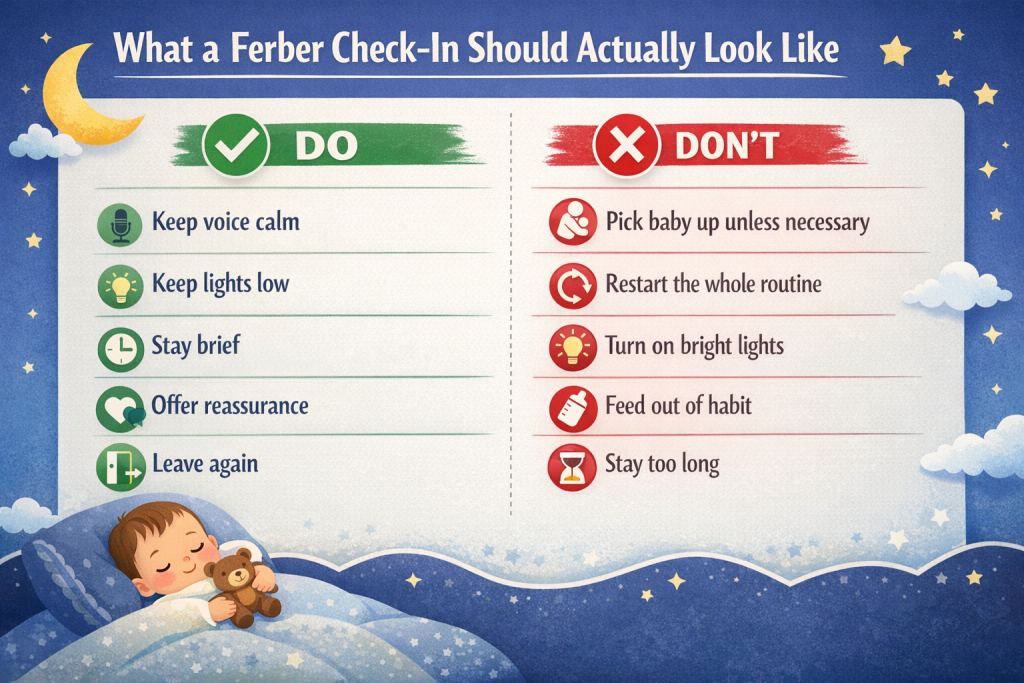
What a check-in should sound like
A check-in is not a full reset. It is more like pressing pause, not rewind.
Go in briefly. Keep the lights low. Use a calm voice. Offer reassurance like, “You’re safe. It’s sleep time. I’m here.” Then leave again. Cleveland Clinic specifically notes that hearing your voice can be soothing during these brief check-ins.
Try not to turn the check-in into rocking, feeding, or a 12-minute cuddle session. Otherwise, your baby may learn that crying brings back the old sleep association.

A sample Ferber schedule for week one
A commonly used version of the schedule looks like this:
Night 1
3 minutes, 5 minutes, 10 minutes, then 10-minute intervals
Night 2
5 minutes, 10 minutes, 12 minutes, then 12-minute intervals
Nights 3 to 4
10 to 12 minutes, then 15 to 17 minutes
Nights 5 to 7
15 to 20 minutes, then 25 to 30 minutes
Sleep Foundation and Cleveland Clinic both note that the intervals can be adjusted, but the core idea stays the same: longer waits, brief reassurance, consistency.
How to handle naps and night wakings
Most families do better if they start with bedtime first.
Why? Because bedtime usually has the strongest sleep pressure. Once bedtime improves, naps and night wakings often get easier too.
For middle-of-the-night wake-ups, use the same basic approach you used at bedtime unless your baby still genuinely needs a feed. If feeding is still part of the plan, keep it quiet and boring. No party lighting. No full wardrobe change unless absolutely necessary.
Common mistakes that can stall progress
Here’s where the ferber method of sleep training often gets wobbly:
- starting when baby is overtired
- changing the plan every night
- making check-ins too long
- putting baby down fully asleep
- mixing five methods in three days
- expecting zero crying on night one
Consistency matters more than perfection. A slightly imperfect plan followed calmly will usually work better than a perfect plan you abandon every 18 minutes.
How long results usually take
Many families notice some improvement within a few nights, even if the first couple feel rough. The first few days are often the toughest. Sleep Foundation notes that if there’s no sign of improvement after about seven days, it makes sense to stop and reevaluate the approach.
So if night one feels messy, that does not mean the method failed. It usually means your baby is learning something brand new.
What the research says about safety and outcomes
This is the part many parents need most, because guilt can get loud.
A 2016 randomized controlled trial on graduated extinction found that graduated extinction and bedtime fading improved sleep outcomes, reduced sleep latency and wake time after sleep onset, and showed no adverse long-term effects on attachment or child emotional and behavioral outcomes.
A 2012 five-year follow-up randomized trial also found no evidence of harm in children’s emotional health, stress regulation, parent-child relationship, or maternal mental health years later.
If you want the original sources for your research-backed section, here are two strong ones:
Helpful products for sleep baby training
These are not magic wands. Still, they can make the routine more consistent and the room more sleep-friendly.
Hatch Rest Baby Sound Machine, Night Light | 2nd Gen
A nursery staple that combines white noise, gentle light, and routine-building features in one device.
Features: sound machine, night light, time-for-bed and time-to-rise functions, touch controls, Wi-Fi support.
Best for: parents who want one product that can grow from baby stage into toddler sleep routines.
Infant Optics DXR-8 PRO Video Baby Monitor
A non-Wi-Fi video monitor that gives you a clear look without app drama.
Features: 720p video, enhanced night vision, 5-inch screen, active noise reduction, closed-circuit hack-proof connection.
Best for: families who want visual reassurance during Ferber check-ins without relying on Wi-Fi.
Momcozy Portable Sound Machine with Night Light
A flexible sound machine you can use in the nursery, stroller, or on the go.
Features: 20 soothing sounds, amber night light, clip-on design, up to 10 hours of battery life, timer.
Best for: parents who want nap-time consistency at home and away.
NICETOWN 100% Blackout Window Curtain Panels
A surprisingly helpful sleep-training tool, especially when sunrise arrives way too early.
Features: full light blocking, thermal insulation, nursery-friendly use, large panel coverage.
Best for: babies who wake with early light or struggle to nap in bright rooms.
VTech Upgraded Audio Baby Monitor with Rechargeable Battery, Long Range, and Crystal-Clear Sound
A simple audio monitor for parents who do not need constant video.
Features: up to 1,000-foot range, DECT 6.0 secure audio, rechargeable parent unit, sound-level indicator, easy plug-and-play setup.
Best for: budget-conscious families who want reliable sound monitoring without extra complexity.
A gentle pre-bed add-on that can help
Not every baby needs a big bedtime production. Sometimes a tiny cue is enough.
If your evenings feel frantic, adding one calming step before the crib can help smooth the transition. A warm bath, a short song, or a simple massage routine can make bedtime feel less like a switch flipping and more like a soft landing. That’s where a guide like baby massage for better sleep can be useful. It is not a replacement for a consistent sleep training method, but it can support the routine around it.
FAQs
Is the ferber method of sleep training safe?
For healthy babies who are developmentally ready, the evidence is reassuring. Research has found sleep benefits without harmful long-term effects on attachment or emotional development. Still, check with your pediatrician first if your baby has weight gain, feeding, or medical concerns.
How long is it okay to let my baby cry with the Ferber method?
There is no single universal number. Ferber uses timed intervals that gradually increase. The goal is brief reassurance, then space to self-soothe, not endless crying with no support.
Can the Ferber method be used during naps too?
Yes, but bedtime is usually the easiest place to start. Once bedtime gets smoother, naps often improve faster because your baby understands the new pattern.
Does the ferber method of sleep training work for breastfed babies?
Yes. Breastfed babies can absolutely learn independent sleep. The key question is not how your baby is fed. It is whether your baby still needs overnight feeds for growth and nutrition.
What if the Ferber method makes things worse?
If crying escalates for several nights with no sign of progress, or the approach feels wrong for your family, stop and reassess. It may be a timing issue, a routine issue, a medical issue, or simply a sign that another method fits your baby better.
Final thoughts
The Ferber method of sleep training does not mean neglecting your baby. It is about helping your baby learn a skill with structure, patience, and loving consistency.
You don’t need to be perfectly composed, and you don’t need to feel completely brave. You simply need to stay consistent.
So start simple. Pick a bedtime routine. Choose your intervals. Keep your check-ins calm. And give the process a real chance before deciding it is not for you.
Because better sleep usually does not arrive in one dramatic movie moment. It shows up a little more quietly than that, one more settled bedtime at a time.