7 Tips For Creating A Bedtime Routine For Babies

We may earn a commission for purchases made using our links. Please see our disclosure to learn more.
Newborn nights can feel like a tiny mystery novel where the plot twist is always another cry at 2:17 a.m. You feed, burp, rock, whisper, sway, and somehow wonder, “Are we doing this right?” A Bedtime Routine For Babies does not magically make a newborn sleep all night, but it can bring more rhythm, comfort, and predictability to your evenings.
Think of it like a soft landing strip. Your baby is not born knowing the difference between day and night, but gentle patterns help their little body learn what comes next. In this guide, you’ll learn how to build a calm newborn sleep routine, create a safe sleep space, use soothing cues, avoid common bedtime mistakes, and choose practical baby care products that support peaceful nights.
What Makes a Bedtime Routine For Babies Work?
A good baby bedtime routine is not about perfection. It is about repetition.
Babies learn through patterns. When the same few steps happen in the same order, your baby starts to recognize the message: “Ah, we are slowing down now.”
A routine may include:
- A warm bath or gentle wipe-down
- Fresh diaper and pajamas
- Feeding and burping
- Dim lights
- A short lullaby
- White noise
- A safe crib or bassinet
For newborns, keep it simple. You are not training a tiny CEO with a color-coded calendar. You are creating comfort.
Tip 1: Start With a Predictable Wind-Down Window
Your newborn does not need a strict bedtime at first. In the early weeks, sleep can look beautifully chaotic. Still, you can start a gentle wind-down window in the evening.
Choose a time when your home naturally quiets down. For some families, that is 7 p.m. For others, especially with older siblings, shift work, or shared living spaces, it may be later.
Watch for Sleepy Cues
Your baby may show signs such as:
- Red eyebrows
- Yawning
- Staring away
- Fussing
- Clenched fists
- Slower movements
Try to start the routine before your baby becomes overtired. An overtired newborn can act like a tiny concert speaker with no off button.
Tip 2: Feed, Burp, and Change Before Sleep
A comfortable baby settles more easily. Before bedtime, offer a feed if your baby is hungry, burp them well, and change their diaper.
This does not guarantee a long stretch of sleep. Newborns wake often because their stomachs are small and their needs are frequent. That is normal newborn baby care, even when it feels endless.
Keep the Order Flexible
Some babies prefer feeding before pajamas. Others relax after a diaper change. You can adjust the order based on your baby’s temperament.
The aim is not a flawless script. The goal is fewer surprises between “almost asleep” and “wide awake again.”

Tip 3: Create a Calm Sleep Environment
Your baby’s sleep space should feel boring in the best way. Think peaceful cave, not festival tent.
Dim the lights. Lower noise. Keep the room comfortably cool. Use a fitted sheet on a firm, flat mattress.
A calm sleep environment for newborns helps separate nighttime from daytime. During the day, let normal household sounds and daylight exist. At night, keep things soft, slow, and quiet.
Use White Noise Carefully
White noise can help mask household sounds, especially if you have pets, siblings, traffic, or neighbors who apparently rearrange furniture at midnight.
Keep the volume down and move the sound machine away from your baby’s head. It should sound like gentle background noise, not a vacuum cleaner having feelings.
Tip 4: Follow Safe Sleep Rules Every Night
Safe sleep matters more than any routine step.
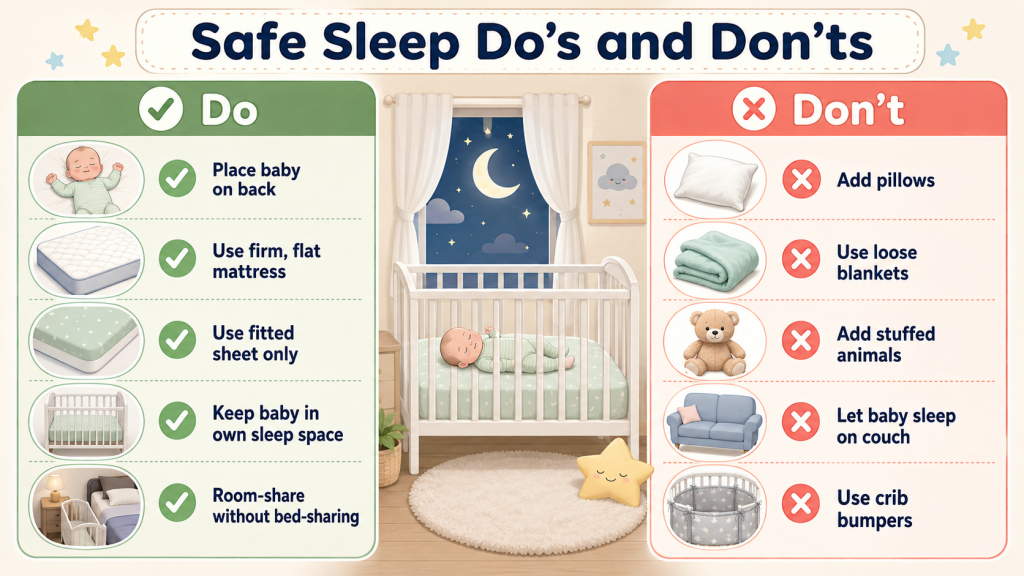
The American Academy of Pediatrics recommends placing infants on their backs, in their own sleep space, on a firm, flat mattress with a fitted sheet, and keeping pillows, blankets, bumpers, stuffed toys, and other soft items out of the crib or bassinet.
The CDC also supports the 2022 AAP recommendations and advises back sleeping for naps and nights, a firm flat surface, room-sharing without bed-sharing, and keeping soft bedding out of the baby’s sleep area.
Room-Share, Don’t Bed-Share
Keeping your baby’s crib, bassinet, or play yard in your room can make night feeds easier while supporting safer sleep. Bed-sharing is not recommended for infants.
Yes, you may feel exhausted. Yes, the couch looks tempting. But couches and armchairs are especially unsafe for sleeping with a baby.
Tip 5: Add Gentle Soothing Cues
Soothing cues are small signals that tell your baby, “You are safe. It is time to rest.”
These can include:
- A soft lullaby
- Gentle rocking before placing baby down
- A pacifier at bedtime
- A quiet phrase like “Night-night, I love you”
- Light swaddling only when developmentally appropriate
The CDC notes that offering a pacifier at nap time and bedtime is one AAP-supported recommendation to help reduce SIDS risk, though breastfeeding families may want to wait until breastfeeding is well established.
Tip 6: Keep Night Wakings Boring—in the Best Way
When your baby wakes at night, keep things calm and low-stimulation.
Make use of low light. Talk quietly. Only change the diaper when necessary. Feed, burp, cuddle briefly, and return your baby to a safe sleep space.
This helps your newborn learn that nighttime is not party time. No bright lights. No big songs. No “guess what your aunt posted on Facebook” energy.

Make Day and Night Feel Different
During the day, open curtains and interact more. At night, stay quiet and cozy. Over time, this supports your baby’s developing baby sleep schedule.
Tip 7: Adjust the Routine as Your Baby Grows
A bedtime routine for newborns should grow with your baby.
At first, bedtime may be more like a repeated rhythm than a set schedule. By a few months old, many babies begin responding more clearly to familiar patterns.
As your baby grows, you might add:
- A short board book
- A baby massage
- A consistent bedtime song
- More predictable nap timing
- A slightly earlier bedtime
If something stops working, that does not mean you failed. Babies change. Their routines need little tune-ups, just like a car, but with more spit-up.
Sample Newborn Bedtime Routine
Here is a simple newborn night routine you can adapt:
- Dim the lights
- Change diaper
- Put on pajamas or sleep sack
- Feed baby
- Burp gently
- Hold upright for a few minutes if needed
- Turn on white noise
- Offer pacifier if you use one
- Place baby on their back in a safe crib or bassinet
Keep the routine around 20–30 minutes. If your baby cries, pause and comfort them. A routine should feel supportive, not like a military drill for someone who cannot hold up their own head yet.
What to Avoid in a Newborn Night Routine
Some bedtime habits seem helpful but can make sleep less safe or more stimulating.
Avoid:
- Loose blankets in the crib
- Pillows or stuffed animals
- Sleeping in swings or car seats outside travel
- Bright screens near bedtime
- Overheating the room
- Long, playful interactions during night wakes
- Using weighted sleep products unless cleared by a professional
Also avoid comparing your baby to someone else’s. One baby sleeps like a tiny angel. Another treats sleep like a suspicious business proposal. Both can be normal.
Newborn Baby Care Tips for Tired Parents
You matter in this routine too.
A calm bedtime starts with a caregiver who has at least a little support. That might mean one parent handles the bath while the other preps bottles. It might mean grandparents help fold laundry. It might mean you leave the dishes because sleep is more important than a heroic kitchen reset.
Try a “Minimum Routine” on Hard Nights
On rough evenings, do the smallest version:
- Diaper
- Feed
- Burp
- Sleep sack
- Safe sleep space
That counts. You do not need the full cozy montage every night.
Best Amazon Products to Support a Baby Bedtime Routine
Before choosing products, remember this: no gadget replaces safe sleep, feeding, comfort, and responsive care. Products should support the routine, not complicate it.
For soothing options, you can also compare this helpful guide to the most recommended pacifiers for babies when choosing a pacifier that fits your baby’s age and needs.
1. Hatch Go Portable Sound Machine for Babies and Kids
The Hatch Go is a portable sound machine with soothing sounds like white noise and shushing. It clips onto strollers or bags, so it works for home naps and travel.
Features:
- 10 soothing sounds
- Portable design
- White noise and shush options
- Baby registry-friendly
Best for: Parents who want a consistent sleep cue at home, during travel, or while visiting family.
2. HALO 100% Cotton Sleepsack Swaddle
The HALO 100% Cotton Sleepsack Swaddle is a wearable blanket with a 3-way adjustable design for newborns 0–3 months.
Features:
- 100% cotton
- Adjustable swaddle style
- TOG 1.5
- Replaces loose blankets
Best for: Newborns who still have a startle reflex and parents who want a safer alternative to loose bedding.
3. Philips Avent Soothie Baby Pacifiers, 0–3 Months
Philips Avent Soothie pacifiers are made for babies 0–3 months and feature a one-piece silicone design.
Features:
- 100% silicone
- One-piece design
- BPA-free
- Designed for newborns
Best for: Parents who want a simple soothing tool for naps and bedtime, especially once feeding is well established.
4. VTech VM819 Non-WiFi Video Baby Monitor
The VTech VM819 is a non-WiFi video monitor with a 2.8-inch screen, night vision, temperature sensor, lullabies, two-way talk, and long battery life.
Features:
- No WiFi required
- Night vision
- Temperature sensor
- Two-way audio
- Lullabies
Best for: Parents who want simple monitoring without relying on a phone app.
5. Munchkin Warm Glow Baby Wipe Warmer
The Munchkin Warm Glow Baby Wipe Warmer includes a soft nightlight for nighttime diaper changes and holds up to 100 wipes.
Features:
- Soft nightlight
- Top-down warming system
- Holds 100 wipes
- Light shuts off automatically
Best for: Parents who want calmer, less startling diaper changes during night wakings.
Research-Backed Reasons Bedtime Routines Help Babies Sleep
A 2009 study summarized by the American Academy of Sleep Medicine found that a consistent bedtime routine improved sleep in infants and toddlers, including sleep onset, night wakings, and maternal mood. The study included 405 mothers and children ages 7–36 months, so it is not newborn-specific, but it supports the bigger idea that predictable nighttime routines can help young children settle more smoothly. Read more from the consistent bedtime routine study summary.
For safety, the strongest guidance comes from AAP-backed safe sleep recommendations. The CDC’s safe sleep area guidance for babies recommends back sleeping, a firm flat sleep surface, room-sharing without bed-sharing, and no soft bedding in the baby’s sleep space.
How Long Should a Baby Bedtime Routine Take?
A baby bedtime routine usually works best when it takes about 20–30 minutes.
For newborns, shorter is often better. A long routine can overstimulate them, especially if they are already tired. Keep it calm, repeatable, and flexible.
If your baby needs extra feeding or soothing, that is okay. The clock is a guide, not a judge.
When Is It Time to Establish a Bedtime Routine for Infants?
You can start a gentle routine in the newborn stage, even in the first few weeks.
At this age, do not expect a strict schedule. Instead, focus on repeated cues: dim lights, feeding, burping, diaper change, soothing, and safe sleep.
By 6–8 weeks, many babies begin responding more noticeably to routines. It’s common for some people to take longer.
Common Bedtime Routine Mistakes Parents Make
The most common mistake is trying to do too much.
A newborn does not need bath, lotion, books, songs, massage, lavender mist, a five-step swaddle strategy, and a moon-phase tracker. Keep it simple.
Other common mistakes include:
- Starting too late
- Making nights too bright
- Skipping burping
- Using unsafe sleep items
- Expecting newborns to sleep through the night
Your baby is learning. So are you.
FAQs About Bedtime Routine For Babies
What is the best Bedtime Routine For Babies?
The best bedtime routine is simple, safe, and repeatable. Try diaper change, pajamas, feeding, burping, dim lights, soothing sound, and placing your baby on their back in a safe crib or bassinet.
How do I get my newborn into a sleep routine?
Start with small cues instead of a strict schedule. Use dim lights, quiet voices, feeding, burping, and the same sleep space each night. Over time, these cues become familiar.
Should I bathe my baby every night before bed?
No, newborns do not need a bath every night. A warm bath can be calming for some babies, but a gentle wipe-down or fresh pajamas can work just as well.
Can I use a pacifier in my baby’s bedtime routine?
Yes, many parents use a pacifier at bedtime. The CDC notes that offering a pacifier at naps and bedtime is part of AAP-supported SIDS risk-reduction guidance, though breastfeeding parents may wait until breastfeeding is established.
Why does my baby cry during the bedtime routine?
Your baby may be overtired, hungry, gassy, overstimulated, or simply needing comfort. Try starting earlier, keeping lights dim, burping well, and shortening the routine.