Most Recommended Pacifiers for Fussy Newborns
We may earn a commission for purchases made using our links. Please see our disclosure to learn more.
Choosing a pacifier sounds simple until you’re standing in the baby aisle at 2 p.m., half-awake, wondering why there are fifty tiny rubber options staring back at you.
If your newborn is fussy, gassy, overtired, or just wants to suck for comfort, the most recommended pacifiers can feel like a small miracle. Not a magic wand, sadly. But pretty close on those long nights when your coffee has gone cold three times.
In this guide, you’ll learn what makes a pacifier safe, which styles parents often love, what experts say, and which Amazon options are worth considering.
What Makes the Most Recommended Pacifiers Worth Buying?
The most recommended pacifiers usually have a few things in common: newborn-safe sizing, soft materials, easy cleaning, good airflow, and a shape babies actually accept.
A good pacifier should not feel like a battle. It should soothe without covering too much of your baby’s face or making you worry every five seconds.
Look for:
- Age-appropriate sizing
- BPA-free materials
- Ventilation holes
- Easy-to-clean design
- A shield wider than baby’s mouth
- A nipple shape your baby tolerates
Some babies love the first one you try. Others act like you handed them a tiny insult. Both reactions are normal.
Quick Buying Checklist for Newborn Pacifiers
Before buying, ask yourself a few simple questions:
- Is it made for 0–3 months or 0–6 months?
- Is it one-piece or easy to inspect?
- Does it have air holes?
- Is the nipple soft but sturdy?
- Can you sterilize it easily?
- Does it match your baby’s feeding style?
For newborn baby care, simple usually wins. You do not need a pacifier that looks like it came from a spaceship. You need one that is safe, soothing, and easy to clean when it inevitably falls on the floor.
Choose the Right Pacifier Material
Most newborn pacifiers use silicone, latex, or natural rubber. Silicone is the most common because it is durable, easy to clean, and less likely to hold odors.
Silicone Pacifiers
Silicone pacifiers are firm, smooth, and practical. They work well for parents who want something easy to sterilize and long-lasting.
Latex or Natural Rubber Pacifiers
Latex and natural rubber feel softer, but they wear down faster. Some babies love the flexible feel, while some parents prefer silicone for hygiene and durability.
If you are unsure, start with silicone. It is the “plain white T-shirt” of pacifiers: simple, useful, and easy to rely on.
Pick a Shape Your Baby Actually Likes
Pacifiers come in different nipple shapes. The right one often depends on your baby’s preference.
Round Pacifiers
Round nipples feel simple and familiar to some babies. They may suit newborns who like a fuller sucking shape.
Orthodontic Pacifiers
Orthodontic pacifiers have a flattened shape designed to support oral development. Many parents choose them when they want a more structured nipple style.
Symmetrical Pacifiers
Symmetrical pacifiers are convenient because there is no “wrong side up.” This is helpful at night when you are trying to replace a pacifier without turning on every light in the house.
Match the Pacifier to Your Baby’s Age
A newborn pacifier should fit a newborn mouth. That sounds obvious, but it matters.
Pacifiers made for older babies may be too large or heavy. For newborns, look for labels like:
- 0–3 months
- 0–6 months
- Newborn
- Stage 1
Once your baby grows, switch sizes as needed. A pacifier is not a “buy once and forget it” item. It is more like baby socks: small, useful, and somehow always needing replacement.
Safety Rules Every Parent Should Know
Safe pacifier use starts with common sense and a few non-negotiables.
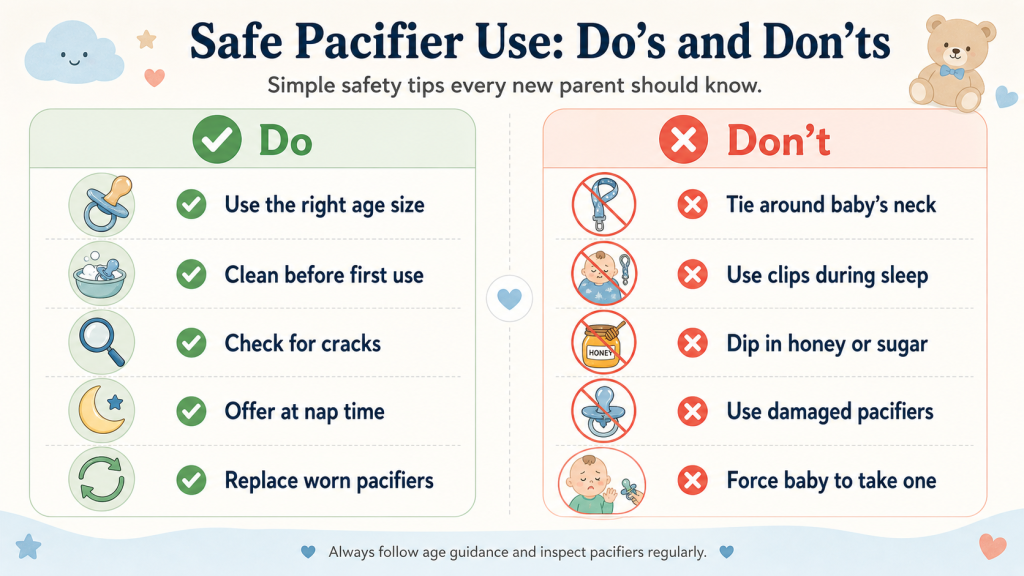
Never put a pacifier around your baby’s neck, cot, or hand. Avoid clips during sleep. Also, never dip a pacifier in honey, sugar, syrup, or juice.
Check pacifiers often. If the nipple looks cracked, sticky, torn, or stretched, toss it.
The American Academy of Pediatrics recommends offering a pacifier at nap time and bedtime as part of safe sleep practices, while still following other safe sleep rules like placing babies on their backs and keeping loose bedding out of the crib.

When Should You Offer a Pacifier?
Offer a pacifier when your baby is calm but needs comfort. You can also try it during naps, bedtime, car rides, or after feeding if your baby still wants to suck.
Try not to use it to delay a feed. If your newborn is hungry, milk comes first. Pacifiers comfort; they do not replace food.
A helpful rhythm looks like this:
- Feed
- Burp
- Cuddle
- Offer pacifier if baby still wants soothing
That small order can save you from guessing whether baby is hungry or just seeking comfort.
Pacifiers and Breastfeeding: What to Consider
Many breastfeeding parents worry about nipple confusion. That concern is understandable.
Some families wait until breastfeeding feels established before offering a pacifier. Others introduce one earlier with guidance from a pediatrician or lactation consultant.
The key is watching your baby. Are they latching well? Gaining weight? Having enough wet diapers? If yes, a pacifier may fit smoothly into your routine.
If feeding feels hard, get support before blaming the pacifier. Newborn feeding is a whole little universe, and nobody should have to navigate it alone.
Pacifiers for Better Sleep Routines
A pacifier can become part of a gentle bedtime routine. It gives your baby a familiar cue: “Okay, we’re winding down now.”
For safe sleep, keep the crib simple. No loose blankets, pillows, stuffed toys, or pacifier clips during sleep. If your baby needs warmth, a wearable sleep sack is usually safer than loose bedding. You can also read this guide on baby sleep sacks for winter if you want help creating a cozy cold-weather sleep setup.
A pacifier is only one piece of the routine. Dim lights, a calm voice, a clean diaper, and a predictable rhythm matter too.
How to Clean and Store Pacifiers
Newborn pacifiers need frequent cleaning. Babies have a gift for dropping things in places you did not know existed.
Basic care tips:
- Wash before first use
- Sterilize as directed by the brand
- Rinse after drops
- Keep extras in a clean case
- Replace worn pacifiers quickly
Keep several on hand. One for the crib, one for the diaper bag, one for the car, and one mystery pacifier that disappears into the parenting void.
5 Pacifier Picks Parents Often Consider
Philips Avent Soothie Baby Pacifiers, 0–3 Months
The Philips Avent Soothie Baby Pacifiers are a classic hospital-style choice. They have a one-piece silicone design and are made for babies 0–3 months. Amazon lists the model as BPA-free, extra durable, and made with 100% silicone.
Features:
- One-piece silicone design
- Newborn-friendly 0–3 month size
- Easy to clean
- Simple round shape
Best for: Parents who want a widely used, simple newborn pacifier.
Dr. Brown’s HappyPaci 100% Silicone Baby Pacifier
Dr. Brown’s HappyPaci is designed for babies 0–6 months and uses a one-piece silicone build. Its bulb shape is similar to Dr. Brown’s bottle nipple, which may help babies who already use that bottle system.
Features:
- 100% silicone
- Contoured butterfly-shaped shield
- Bottle-nipple-inspired shape
- Lightweight feel
Best for: Bottle-fed babies or parents using Dr. Brown’s bottles.
MAM Original Start Matte Baby Pacifiers, 0–3 Months
MAM Original Start Matte Baby Pacifiers use medical-grade silicone and a symmetrical nipple. Amazon’s product details note that they were developed with orthodontists and pediatric dentists and feature a breathable curved shield.
Features:
- Symmetrical nipple
- SkinSoft silicone
- Breathable shield
- Designed for newborns
Best for: Babies who prefer a softer, flatter nipple shape.
Tommee Tippee Ultra-Light Silicone Pacifier, 0–6 Months
The Tommee Tippee Ultra-Light Silicone Pacifier is designed to stay put with a lightweight silicone build. It also has a symmetrical nipple and air holes to help protect sensitive skin.
Features:
- Lightweight one-piece silicone
- Symmetrical nipple
- Air holes for breathability
- BPA-free silicone
Best for: Babies who spit out heavier pacifiers.
NUK Timeless Comfy Pacifier, 0–6M
The NUK Timeless Comfy Pacifier has a one-piece silicone design and is made for babies 0–6 months. Amazon lists it as BPA-free, gentle on baby’s skin, and designed with NUK’s orthodontic nipple shape.
Features:
- 100% silicone
- One-piece design
- Orthodontic nipple
- Newborn-friendly size
Best for: Parents who want an orthodontic-style pacifier for early use.
Research-Backed Reasons Pacifiers Can Help
Pacifiers are not just cute baby accessories. Experts have studied how they may support soothing and safe sleep, especially during naps and bedtime.
The AAP safe sleep pacifier recommendation says offering a pacifier at nap time and bedtime may help reduce the risk of sleep-related infant death. The AAP also notes that if the pacifier falls out after sleep begins, parents do not need to put it back in.
A Cochrane review on pacifiers and SIDS looked at the link between pacifier use during sleep and SIDS prevention. While the review notes that randomized trial evidence is limited, it still supports why many pediatric experts include pacifiers in safe-sleep conversations.
The American Academy of Pediatric Dentistry pacifier policy also explains that pacifiers can be appropriate for infants when parents choose safe, age-appropriate options and monitor use as the baby grows.
Pacifier Use Looks Different in Every Family
Some families call it a pacifier. Others say binky, dummy, soother, or chupón. The name changes, but the goal stays the same: comfort.
Your baby’s routine might not look like your sister’s, your neighbor’s, or that perfectly lit parenting video online. That is okay.
Some babies use pacifiers only for sleep. Some need them during car rides. Some reject every option like tiny product testers with very strong opinions.
The best pacifier is the one that fits your baby safely and helps your family breathe a little easier.
Common Pacifier Mistakes to Avoid
Even the most recommended pacifiers can cause problems if used the wrong way.
Avoid these mistakes:
- Buying the wrong age size
- Keeping old pacifiers too long
- Using clips during sleep
- Dipping pacifiers in sweet foods
- Using a pacifier to delay hunger
- Ignoring cracks or sticky texture
- Forcing a pacifier on a baby who hates it
If your baby refuses one style, try another. But if they keep rejecting pacifiers, that is not failure. Some babies prefer rocking, feeding, swaddling, white noise, or skin-to-skin cuddles.
FAQs About the Most Recommended Pacifiers
What are the most recommended pacifiers for newborns?
The most recommended pacifiers for newborns are usually soft silicone options made for 0–3 or 0–6 months. Popular choices include Philips Avent Soothie, Dr. Brown’s HappyPaci, MAM Original Start, Tommee Tippee Ultra-Light, and NUK Comfy.
Are pacifiers safe for newborn sleep?
Yes, pacifiers can be safe for newborn sleep when used correctly. Offer one at nap time or bedtime, but do not attach clips, cords, stuffed animals, or straps while your baby sleeps.
How many pacifiers are required for a newborn?
Most parents do well with 4–6 pacifiers. Keep one near the crib, one in the diaper bag, one in the car, and a few clean backups at home.
When should I replace a baby pacifier?
Replace a pacifier if it looks cracked, sticky, torn, discolored, or stretched. Also follow the brand’s replacement guidance, especially if your baby uses it daily.
What happens if my infant dislikes pacifiers?
That is completely normal. Try a different shape or material, but do not force it. Some babies prefer other soothing methods, and that does not mean you are doing anything wrong.
Final Thoughts on Choosing the Best Pacifier
The most recommended pacifiers are not about chasing the fanciest baby product. They are about finding a safe, comfortable little tool that helps your newborn settle when the world feels big, bright, and overwhelming.
Start with newborn sizing, choose safe materials, clean often, and pay attention to your baby’s cues. Maybe your baby loves the first pacifier you try. Maybe they make you audition five like a tiny boss. You’ll figure it out either way.
Making flawless decisions is not the goal of parenting. It is about learning your baby, one sleepy cuddle at a time.