Cry It Out Ferber: A Practical Guide to Graduated Sleep Training

We may earn a commission for purchases made using our links. Please see our disclosure to learn more.
If bedtime has become a long cycle of rocking, feeding, bouncing, or repeated wake-ups, you may be wondering whether cry it out ferber sleep training could help. The name can sound harsher than the method actually is. Ferber-style training uses planned, gradually lengthened check-ins rather than leaving a baby alone indefinitely.
This guide explains how the method works, when families consider it, what research says, and how safe-sleep guidance fits in. You’ll also find preparation steps, useful products, common mistakes, and FAQs. Most importantly, you’ll see where flexibility matters and where safety should never bend.
What Is the Cry It Out Ferber Method?
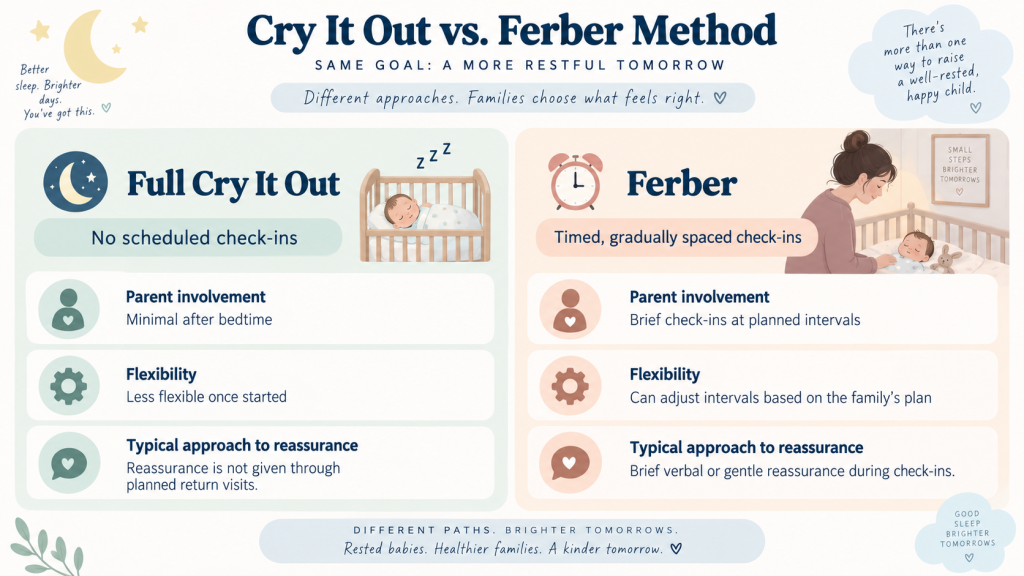
The cry it out ferber method is a form of graduated extinction associated with pediatrician Richard Ferber. You wait for a planned interval after bedtime crying begins, briefly check in, then leave while your baby is still awake. The waits typically lengthen through the night and over successive nights. Cleveland Clinic describes the approach as timed reassurance rather than unlimited crying.
The goal is to reduce the help a baby needs to fall asleep while still allowing reassurance.
Cry It Out vs. Ferber: The Difference Matters
“Cry it out” is an umbrella phrase. Full extinction generally means not returning for ordinary bedtime crying until a planned feed or morning, assuming the baby is safe. Ferber instead uses check-ins after increasing waits.
Some parents find graduated check-ins manageable, while some babies become more upset when a parent repeatedly enters and leaves.
When Is Ferber Sleep Training Appropriate for a Baby?
Formal sleep training is often discussed around four to six months, but readiness varies. Cleveland Clinic notes that parents commonly start around four months while emphasizing that every baby is different.
Before starting cry it out ferber, consider growth, feeding needs, illness, breathing issues, or other medical factors. Sleep training and night weaning differ. If you are unsure about feeds, growth, or symptoms, ask your pediatric clinician first.

How to Prepare Before the First Night
Use a short wind-down you can repeat: dim lights, feed if appropriate, change the diaper, put on sleep clothing, read or sing, then place your baby in the sleep space awake. Predictability matters more than an elaborate routine.
If evenings currently feel chaotic, a consistent bedtime routine for babies can create predictable cues before you start formal sleep training.
Agree on who handles check-ins, when to intervene immediately, and how planned feeds will work.
Cry It Out Ferber Schedule: How Timed Check-Ins Work
A practical cry it out ferber plan uses waits that gradually lengthen. A family might choose 3, 5, and 10 minutes on the first night, then longer waits later. Those numbers are only an example.
Start the timer when crying begins and return briefly when the interval ends. Respond sooner if your baby seems sick, injured, has trouble breathing, or needs care. Safety and judgment come first.
Try not to rewrite the rules every few minutes. A predictable response pattern makes the method easier to assess.
What to Do During Each Check-In
Keep each visit calm and low-stimulation. You might speak softly or repeat the same phrase. The purpose is brief reassurance.
Avoid turning every visit into feeding, rocking, or play unless your baby needs it. Leave while your baby is awake. If check-ins consistently make distress much worse, longer intervals, shorter visits, or a gentler method may fit better.
What to Expect During the First Few Nights
Progress is rarely linear. A baby may settle faster one night and protest more the next because naps, teething, or daily variation changed.
Track bedtime, settling time, check-ins, feeds, and unusual disruptions to spot a pattern.
Consistency never means ignoring illness, unusual crying, or a plan that feels unmanageable.

Research-Backed Evidence on Graduated Extinction
A 2016 randomized trial in Pediatrics studied 43 infants ages 6 to 16 months assigned to graduated extinction, bedtime fading, or sleep education. The sleep interventions improved measured sleep outcomes, and researchers did not find significant differences in attachment or later emotional and behavioral outcomes at the 12-month follow-up.
A 2012 Pediatrics five-year follow-up study assessed 225 families about five years after a behavioral infant sleep intervention. Researchers reported no marked long-term differences in child emotional or conduct outcomes, parent-child closeness or conflict, or several measures of parent well-being.
These findings are reassuring, but they do not prove that cry it out ferber is best for every baby. The 2016 trial was small. Graduated extinction is one evidence-supported option, not a requirement, and safe-sleep guidance still applies.
Safe Sleep Rules Still Apply During Ferber
Sleep training changes your response to bedtime crying; it should not change the sleep setup. The American Academy of Pediatrics recommends placing infants on their backs, using a firm, flat, non-inclined sleep surface, keeping soft objects and loose bedding out, and room-sharing without bed-sharing for at least the first six months when possible.
Do not add pillows, positioners, weighted blankets, loose blankets, or soft toys to make cry it out ferber easier. Keep device cords out of reach.
When to Pause or Choose Another Method
Pause when your baby is sick, in obvious pain, has breathing difficulty, vomits repeatedly, or shows another sign of a real need. Travel or a major schedule disruption can also justify waiting.
You may choose another method because timed crying does not fit your family. Bedtime fading, chair methods, or gradually reducing rocking can reduce support more slowly. A calm, workable plan is more useful than one caregivers dread.
Common Mistakes That Make Ferber Harder
Common mistakes include starting without a response plan, treating sleep training as automatic night weaning, and making check-ins too stimulating.
Watch the clock, but watch your baby too. Cry it out ferber is a structure, not a reason to override judgment. If your baby sounds or looks different from normal bedtime protest, check. Constantly changing intervals, however, makes the plan harder to evaluate.
Protect naps where practical. An overtired baby may struggle at bedtime, while a baby who is not sleepy yet can resist for another reason.
Recommended Products for Cry It Out Ferber Sleep Training
Products cannot teach independent sleep, but a few tools can support consistent routines or monitoring. These five serve different needs.
| Product | Best for | Useful feature | Consideration |
| Hatch Rest 2nd Gen | Routine cues | App-controlled sound and light | More setup than a basic machine |
| Yogasleep Hushh | Travel | Portable sound machine | Keep out of reach |
| Munchkin Shhh… | Simple setup | Three sound choices | Timed shutoff |
| NICETOWN Blackout Curtains | Bright bedrooms | Blackout liner | Measure first |
| Infant Optics DXR-8 PRO | No-Wi-Fi monitoring | Dedicated display | No remote phone viewing |
Hatch Rest 2nd Gen Baby Sound Machine & Night Light (White) | White noise machine, night light, toddler & kid time-to-rise alarm clock, nursery stories, control via Hatch Sleep App
Best for: Families who want repeatable bedtime cues
This device combines white noise, a night light, time-to-rise functions, stories, and app control. It fits cry it out ferber routines where caregivers want consistent sound and light cues before bed, with features that can later support toddler routines. Families wanting a one-button sound machine may not need the extra controls.
Yogasleep Hushh Portable White Noise Sound Machine for Baby, 3 Soothing Natural Sounds with Volume Control, Compact Size, Noise Canceling for Sleep Aid, Office Privacy, & Meditation, Registry Gift
Best for: Travel and small spaces
The Hushh is small, rechargeable, and includes three sound options with adjustable volume, so you can easily bring a familiar sleep cue from home while traveling. Portability is its practical strength. As with any electronic nursery item, keep it outside the sleep space and where a baby cannot reach it.
Munchkin Shhh… White Noise Sound Machine, Baby Soother, White/Grey
Best for: A simple, lower-cost routine tool
This small machine offers shushing, heartbeat, and white-noise sounds plus a soft night light. It is battery-operated and has 10-, 20-, and 30-minute automatic shutoff choices, suiting caregivers who want straightforward controls without an app. The timer may not suit families who prefer continuous sound overnight.
NICETOWN White 100% Blackout Curtains 84 inch Long for Bedroom 2 Pieces
Best for: Nurseries with early sunrise or streetlight
These two-panel curtains use a blackout liner designed to block outside light, helping keep the room environment more consistent across bedtime and early morning. They are useful in bright bedrooms or during seasonal daylight changes. Measure the window carefully, because coverage depends on curtain width, length, and rod placement.
Infant Optics DXR-8 PRO – Patented Active Noise Reduction (ANR), 5” HD Video Baby Monitor with 1 Camera, No WiFi, Hack-Proof,Pan Tilt Zoom, Interchangeable Lens
Best for: Caregivers who prefer a dedicated, no-Wi-Fi monitor
The DXR-8 PRO uses a dedicated display and includes pan, tilt, zoom, and active noise reduction. That can help caregivers visually check a baby before deciding whether a timed visit is needed. Its no-Wi-Fi design means it is intended for local viewing rather than remote monitoring through a phone.
Adapting Ferber for Different Families and Temperaments
A textbook schedule may not fit shift-working parents, room-sharing siblings, twins, or different temperaments. Keep the principle—predictable chances to settle with less help—while adjusting logistics that do not compromise safety.
For siblings, staggered bedtimes may help. With twins, separate check-in decisions may be necessary. When room sharing, parents may begin the night outside the room.
Judge progress across several nights rather than comparing timelines. Ask whether bedtime is becoming more manageable without compromising feeding, safe sleep, or responsive care.
Frequently Asked Questions About Cry It Out Ferber
Is Ferber the same as leaving a baby to cry all night?
No. Ferber is graduated extinction: caregivers return for brief check-ins after planned waits. Full extinction usually involves no routine check-ins during settling. In cry it out ferber, those timed visits are central, although you should still respond immediately to signs of illness, injury, breathing problems, or another genuine need.
How long should I wait before the first check-in?
There is no universal interval every family must use. Classic Ferber schedules use progressively longer waits, while current clinical guidance often emphasizes manageable intervals and consistency. A first wait of a few minutes is one common example. If your baby has medical or feeding concerns, get individualized guidance rather than relying on a generic chart.
Does Ferber mean that I must stop feeding at night?
No. Sleep training and night weaning are two different things. A baby can practice settling at bedtime and still need overnight feeds based on age, growth, feeding pattern, and clinical advice. Decide beforehand how you will handle expected feeds so hunger is not treated as routine protest. Ask your pediatric clinician before changing feeds if you are uncertain.
What should I do if my baby cries even more during check-ins?
That can happen. Seeing a parent briefly and then watching them leave may re-energize some babies. If the pattern repeats, consider longer intervals, shorter visits, or a different method. A check-in is meant to reassure; if it consistently makes settling much harder, adjusting the plan is reasonable.
Is cry it out ferber harmful to attachment?
Available randomized studies have not found evidence of worse attachment or long-term emotional outcomes from graduated-extinction interventions, but the evidence has limits and cannot guarantee an outcome for every family. Attachment develops through the broader pattern of caregiving, not one bedtime technique alone. If this method causes significant concern, choosing a gentler approach is reasonable.
Is Cry It Out Ferber Right for Your Family?
Cry it out ferber can be a practical middle ground for families who want structured sleep training while keeping scheduled reassurance. Focus on readiness, a predictable bedtime routine, safe sleep, a clear plan for feeds and genuine needs, and caregivers who can follow the approach calmly.
For repeatable smart routine cues, Hatch Rest 2nd Gen offers flexibility. For a portable sound cue, Yogasleep Hushh keeps things simpler. Neither product replaces the method itself.
Choose Ferber because its structure fits your baby and household—not because you feel pressured by someone else’s timeline. Start with a clear plan, keep safety non-negotiable, and change course if the approach is not working well for your family.