Split Nights In Babies: Why They Happen & How To Fix Them

We may earn a commission for purchases made using our links. Please see our disclosure to learn more.
Your baby falls asleep without much fuss, then wakes at 2 a.m. and stays wide awake. You feed, change, and cuddle them, but sleep seems nowhere in sight. If this pattern feels familiar, your baby may be experiencing split nights.
A split night is prolonged wakefulness between nighttime sleep periods. Repeated episodes can exhaust the household. Looking at daily sleep can reveal useful adjustments. This guide explains possible causes, how to distinguish a schedule problem from discomfort, and what to do tonight and over the following days without compromising safe sleep.
What Are Split Nights In Babies?
A split night is a long awake period in the middle of the night, often lasting an hour or more, followed by another stretch of sleep. Some babies babble or roll around happily; others become frustrated when they cannot settle.
The term is a description, not a medical diagnosis. One wakeful night is not a pattern. Newborns naturally wake for feeds. Split nights become more useful to investigate when an older baby repeatedly seems alert at night despite having a reasonable opportunity to sleep.
Why Does a Baby Wake Up for Hours at Night?
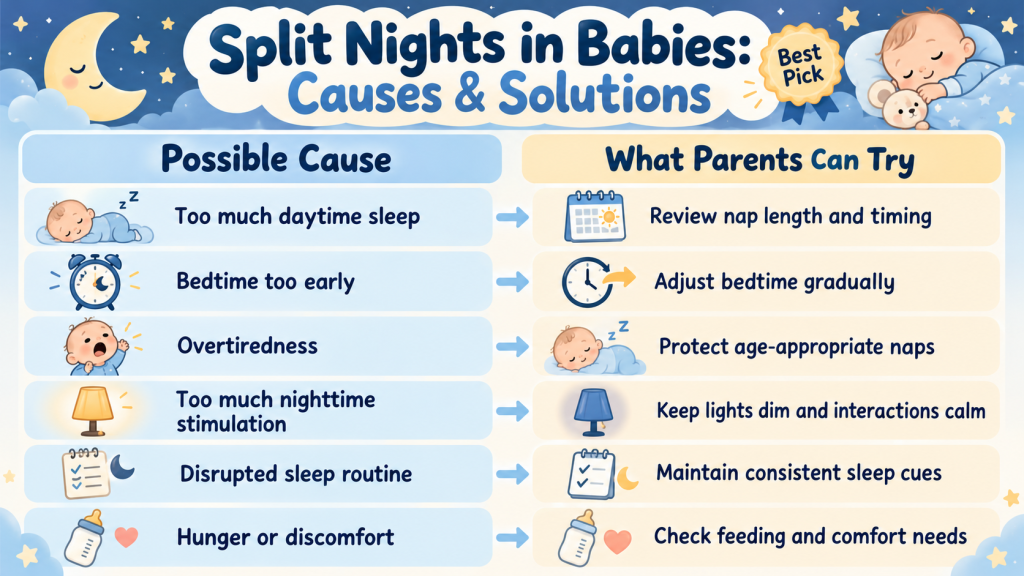
Sometimes a baby’s schedule allows more time in bed than their current sleep need. After several hours, they may lack enough sleep pressure—the drive that builds during wakefulness—to settle again.
Poor naps or disrupted evenings may also leave babies overtired. Separation anxiety, exciting new skills, changes in routine, and noisy surroundings can further complicate matters.
Look for patterns rather than assuming your baby needs less sleep.

Split Nights Versus Normal Night Wakings
Brief awakenings between sleep cycles are normal, including for babies who generally sleep well. They may stir, feed, or need help settling.
Consider three clues: duration, alertness, and repetition. Is your baby awake for an extended stretch? Do they seem ready to play rather than drift off? Has this happened across several nights?
Pain, coughing, breathing difficulty, or inconsolable crying suggest other causes. Address those needs first instead of interpreting every long waking as a harmless sleep pattern.
If this pattern feels familiar, your baby may be experiencing split nights.
Sleep requirements vary, but age-based ranges provide useful context. Count naps and nighttime sleep together rather than focusing solely on how long your baby stays in the crib.
| Age | Recommended total sleep per 24 hours |
| Birth–3 months | 14–17 hours, with substantial individual variation |
| 4–12 months | 12–16 hours, including naps |
| 1–2 years | 11–14 hours, including naps |
These are broad guidelines. A baby sleeping more during the day may need a shorter night. Never restrict feeding or rest to fit a chart.
How Naps Can Contribute to Split Nights
Naps influence how sleepy your baby feels at bedtime. A long late-afternoon nap might push the next natural sleep period later, while skipping needed daytime rest can bring fussiness and difficult settling.
Review nap timing, duration, and your baby’s behavior afterward. Avoid waking a newborn to enforce an older baby’s schedule. For an older, thriving baby, consider adjusting a consistently late nap.
Change only one nap variable initially. Cutting naps sharply may worsen nights.
Could Bedtime Be Too Early or Too Late?
A bedtime that once worked can become mismatched as your baby grows. If a baby regularly sleeps a substantial first stretch, spends hours awake, then sleeps again, an overly long planned night may be worth examining.
After poor naps, an earlier bedtime may help. A cheerful baby awake for hours may benefit from a slightly later one.
Consider tired cues, morning wake time, and total sleep instead of rigid wake windows. Move bedtime gradually and assess the overall pattern.

Rule Out Hunger, Illness, and Developmental Changes
Before adjusting schedules, check whether your baby needs a feed, diaper change, comfort, or medical attention. Younger infants and some older babies still need nighttime feeding. Do not night-wean based on an internet timetable.
Teething, congestion, ear infections, reflux symptoms, travel, or new motor skills can interrupt sleep.
If unwell, prioritize care. Revisit schedules after recovery.
How to Fix Split Nights in Babies Step by Step
Keep a three- to five-day record of bedtime, naps, long wakings, wake time, and feeding or health changes. A sleep log for babies can help you spot the pattern.
Next, compare total sleep with the broad age-appropriate range and check whether the available night is realistic. Make one modest change, such as shifting bedtime by 10–15 minutes or adjusting a consistently late nap.
Keep morning and bedtime cues steady. Look for shorter wakings without daytime tiredness. If things worsen, seek guidance.
What to Do When Your Baby Is Awake at 2 A.M.
Keep the room dim and your voice quiet. Offer needed feeding, a diaper change, or reassurance, but skip bright lights, toys, screens, and energetic conversation. Keep nighttime restful.
If your baby is calm and safe, allow time to resettle. Respond promptly to distress, hunger, or signs of illness. Do not leave a young infant waiting for needed care.
Once needs are met, stick with a familiar settling approach.
Create a Comfortable and Safe Sleep Environment
A dark, reasonably quiet room can reduce unnecessary stimulation. Blackout curtains or quiet background sound may limit distractions but cannot cure split nights.
For babies younger than one year, always place them on their back on a firm, flat, separate sleep surface with a fitted sheet only. Keep pillows, loose blankets, toys, and weighted sleep products out. Share a room without sharing a bed for at least six months.
Keep curtains, cords, monitors, and sound machines out of reach of the crib. Check clothing and room comfort without overheating your baby.
When Should You Contact Your Pediatrician?
Speak with your pediatrician if long nighttime waking persists despite gentle routine adjustments, or if it affects feeding, growth, or your baby’s daytime well-being. Bring a sleep log to the appointment.
Seek medical advice for frequent snoring, gasping, unusual movements, significant pain, vomiting, dehydration, or persistent distress. Breathing difficulty, blue or gray coloring, or difficulty waking requires emergency help.
For a baby three months old or younger, a rectal temperature of 100.4°F (38°C) or higher calls for immediate medical assessment. Do not try to solve warning signs by changing nap schedules.
Recommended Products for Split Nights In Babies
Products are optional support tools, not cures. Choose only what addresses a real issue in your baby’s room or routine.
Hatch Rest 2nd Gen Baby Sound Machine & Night Light (White)
Best for: Consistent bedtime cues
The Hatch Rest combines adjustable sleep sounds, a night light, and app-controlled routines in one nursery device. It can maintain familiar signals when you’re adjusting bedtime or settling after a waking. However, its connected features may be unnecessary if you prefer simple controls, and it should be placed away from the crib at a low volume.
NICETOWN White 100% Blackout Curtains, 84 Inch Long, 2 Pieces
Best for: Rooms with disruptive light
These two curtain panels feature a blackout lining intended to reduce sunlight and outside lighting. They may help make naps and early mornings less dependent on changing daylight. Each panel measures 52 by 84 inches, so measure your window first; gaps around the edges can undermine the darkening effect. Secure cords and fabric well away from the crib.
HALO SleepSack 100% Cotton Wearable Blanket, 0.5 TOG, Sage Woodland, Medium, 6–12 Months
Best for: Wearable warmth without loose bedding
This lightweight cotton wearable blanket has a roomy lower section and a zipper for changes. It can replace a loose blanket when the size and room conditions are appropriate. The medium is intended for babies within the manufacturer’s age and fit range; avoid using an oversized sack or adding extra layers that make your baby hot.
VTech Communications DM221 Audio Baby Monitor, White/Silver
Best for: Simple sound-only monitoring
The DM221 uses digital audio transmission, a sound-level display, a vibrating alert, and two-way talk. It lets caregivers hear nighttime activity without keeping a bright video screen nearby. It cannot show whether a baby has moved position or explain why they are awake. Keep the baby unit and its power cord safely outside the crib.
TempPro TP50 Digital Hygrometer Indoor Thermometer
Best for: Checking nursery temperature and humidity
The TP50 displays indoor temperature and relative humidity, providing quick context if the nursery sometimes feels unusually warm or dry. Its simple readout is useful when making comfort adjustments, but it is not a medical monitor and cannot diagnose why your baby wakes. Keep the device and any batteries completely out of your baby’s reach.
What Research Says About Infant Sleep and Night Wakings
The American Academy of Sleep Medicine’s 2016 consensus statement recommends 12–16 hours of total daily sleep for ages 4–12 months and 11–14 hours for ages 1–2 years. These broad ranges help parents assess sleep opportunity; they do not prescribe an exact bedtime.
A 2016 randomized trial of behavioral sleep interventions involving 43 infants aged 6–16 months found improvements in some sleep measures with bedtime fading or graduated extinction. The small study does not prove that either approach fixes split nights specifically.
The American Academy of Pediatrics’ sleep guidance also emphasizes calm nights and normal variation in infant sleep. Use research to inform gentle changes, not to override feeding needs or safe-sleep rules.
Frequently Asked Questions About Split Nights In Babies
How long do split nights usually last?
There is no scientifically established number of nights that every split-night episode lasts. Some improve after a temporary disruption passes; others continue until a schedule mismatch or medical concern is addressed. Record several days of sleep and look for a trend. If long wakings persist, worsen, or affect your baby’s well-being, ask your pediatrician.
Are Split Nights the Same Thing as a Sleep Regression?
No. A split night describes an extended awake stretch between nighttime sleep periods. Sleep regression is a broader parenting term for changes such as nap resistance, frequent waking, or harder settling. They can overlap, particularly during developmental transitions, but the labels do not identify the cause. Investigate timing and health rather than assuming one fixed developmental stage is responsible.
Should I shorten my baby’s daytime naps?
Not automatically. Babies need daytime sleep, and cutting naps abruptly can leave them overtired. First check the total amount and placement of sleep over a full day. If an older baby’s very late or lengthy nap repeatedly delays sleep, consider a modest adjustment. Ask your pediatrician before restricting sleep in a newborn or a baby with feeding or growth concerns.
Can teething cause a baby to stay awake for hours?
Teething discomfort may interrupt sleep, but a long waking is not proof that teething is the cause. Look for other symptoms, feeding changes, fever, or signs of illness instead of attributing everything to emerging teeth. Ask your pediatrician about suitable pain relief. If your baby seems comfortable and playful, review the sleep schedule as well.
Will sleep training fix split nights in babies?
Not necessarily. Some age-appropriate behavioral approaches improve settling and reduce waking, but a baby who is simply not sleepy may still remain awake. Address sleep opportunity, naps, illness, and feeding needs first. For young infants, premature babies, or children with health conditions, discuss any formal sleep-training plan with your pediatrician before making changes.
Conclusion: A Practical Plan for Better Nights
Split Nights In Babies can feel endless when you’re awake in the middle of one, but a pattern is easier to understand when you look at the whole day. Check feeding and health needs first, then track naps, total sleep, bedtime, and morning wake time. Make small, consistent adjustments instead of cutting sleep sharply or changing everything overnight.
For troublesome light, consider NICETOWN curtains; for consistent bedtime cues, Hatch Rest may help. Neither replaces an age-appropriate routine or a safe crib. Keep overnight responses calm, watch for concerning symptoms, and seek pediatric advice when long wakings persist. Start with your baby’s needs, not a rigid schedule.