Best Infant Noise Machine: A Practical Buying Guide for Calmer Sleep
We may earn a commission for purchases made using our links. Please see our disclosure to learn more.
When a dog, doorbell, or older sibling keeps interrupting naps, an infant noise machine can make the nursery sound more consistent. It cannot solve hunger, illness, discomfort, or an unsuitable schedule, and it never replaces safe-sleep practices. Steady sound may soften household noise and become a familiar bedtime cue. The challenge is separating useful controls from a crowded feature list. This guide compares six distinct products, explains the evidence on white noise, and helps you judge sound type, volume, power, portability, lighting, and app features. You should finish knowing which machine fits your room, routine, and budget.
What an Infant Noise Machine Can—and Cannot—Do
A sound machine reduces the contrast between a quiet room and sudden traffic, voices, or dishes. That masking effect is its main value.
It remains a sleep cue, not a treatment or safety device. It cannot prevent sleep-related infant death, correct an unsafe sleep space, or fix waking caused by feeding, pain, temperature, or illness. It is one supportive part of bedtime, not the foundation.
Choose the Sound Character Before Counting Tracks
Models may offer white, pink, brown, fan, rain, surf, and lullaby tracks. White noise can sound hissy; pink and brown noise usually sound deeper. Mechanical models use a real internal fan.
More tracks do not guarantee value. Many families use one steady sound. Prioritize a pleasant tone, small volume steps, and no obvious loop. Waves or bird calls may stand out enough to disturb a light sleeper.
Volume Control and Placement Matter Most
A percentage setting means little because output changes with the speaker, track, distance, and room. Keep the unit well away from the crib, never inside or attached to it, and route cords out of reach.
Start at the lowest useful level. Check near your baby’s head position with a sound-level meter. A phone app offers only a rough, uncalibrated reading.
Look for Controls You Can Use Half-Asleep
At 2 a.m., clear buttons beat a long feature list. Raised controls, remembered settings, a child lock, and small volume steps improve everyday use. Timers suit short settling periods; continuous play avoids an abrupt stop.
App control is convenient across the room, but power and volume should also work without a phone. Accounts, subscriptions, Wi-Fi setup, and bright status lights may add needless friction.
Match the Power Source to Your Routine
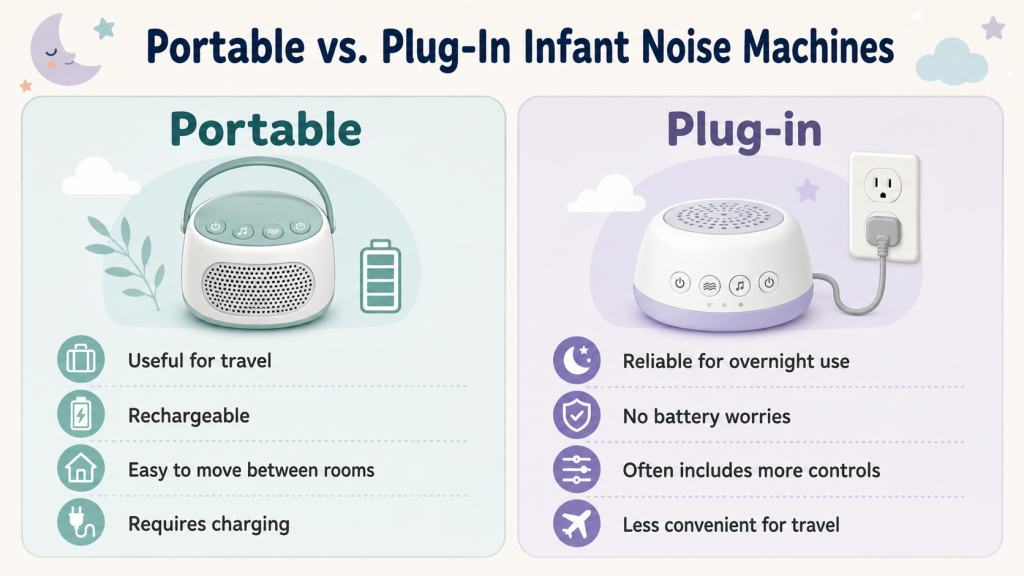
A plug-in model suits a permanent nursery and removes battery anxiety. Rechargeable units fit naps around the house and travel, although runtime changes with volume, lighting, settings, and battery age.
Check the charging port, physical switch, hanging loop, and button lock. Portability only helps when the unit stays charged and can sit safely away from a portable crib. Always pack its cable.
Treat Night-Lights and Smart Features as Extras
A dim, adjustable night-light can help during feeds and diaper changes. However, light is not essential to masking, and a lamp that stays too bright may distract.
Scheduling and time-to-rise tools become more useful in toddlerhood. Confirm what works without a subscription. Smart features should support your family’s routine, not turn a simple bedtime tool into another account to manage.
Research-Backed Guidance on White Noise and Infant Sleep
Evidence suggests possible short-term benefit, not guaranteed better sleep. A 1990 randomized trial of 40 newborns found that 16 of 20 exposed to white noise fell asleep within five minutes, versus 5 of 20 controls. Its small sample does not answer questions about long-term nightly use.
Output is the clearer concern. A 2014 study of 14 infant sleep machines found all exceeded 50 dBA at maximum volume from 30 centimeters; three exceeded 85 dBA. It measured devices, not hearing outcomes, but shows why maximum volume near a crib is unwise.
The American Academy of Pediatrics’ 2023 guidance advises maximum practical distance, low settings, and limited duration. A 2024 review found long-term developmental evidence remains limited. Favor distance, precise control, modest output, and varied normal sound while your baby is awake.
Recommended Infant Noise Machine Options
The best model depends on whether you need a fixed nursery station, portable backup, real-fan sound, broad digital choice, or long-term routine features.
| Product | Best fit | Sound | Power | Consideration |
| Hatch Baby Sound Machine | Evolving routines | Digital plus light | Plug-in | Optional paid content |
| Yogasleep Hushh 2 | Travel and naps | Six digital sounds | Rechargeable | Placement still matters |
| Yogasleep Dohm Classic | Simple fan sound | Real fan | Plug-in | Limited adjustment |
| LectroFan EVO | Noisy homes | 22 digital sounds | USB/plug-in | Strong maximum output |
| Dreamegg D11 Max | Portable value | 21 digital sounds | Rechargeable | Busier controls |
| SNOOZ Original | Premium fan control | Real fan | Plug-in | Higher cost |
Hatch Baby Sound Machine & Night Light Routine Builder (Putty)
Best for: Families wanting one routine device from infancy into toddlerhood
This plug-in model combines digital sounds, a dimmable color light, scheduling, and time-to-rise routines. Remote adjustment helps when it sits across the nursery, while the routine tools can remain relevant as a child grows. Confirm which content is included without an optional plan and whether you want another app-connected device.
Yogasleep Hushh 2 Portable Sound Machine for Baby & Kids
Best for: Frequent travel, stroller naps, and moving between rooms
The Hushh 2 provides six sounds, adjustable volume, a rechargeable battery, timer, backlit buttons, night-light, reinforced clip, and child lock. Its compact body packs easily and works without a nearby outlet. The clip does not make close crib placement appropriate; keep the speaker away from the baby’s ears and outside the sleep space.
Yogasleep Dohm Classic (White) The Original White Noise Sound Machine
Best for: Parents who prefer simple, non-looping mechanical fan sound
The Dohm Classic uses an internal fan instead of a recorded track. Two speeds and a rotating cap adjust tone and output without an app, account, or subscription, making it easy to operate in the dark. Its tradeoffs are outlet-only power and less precise volume adjustment than digital machines with many incremental settings.
Adaptive Sound Technologies LectroFan EVO Sound Machine, White
Best for: Apartments, traffic noise, and fine sound selection
LectroFan EVO offers 22 non-looping fan, noise, and ocean sounds, precision volume buttons, a sleep timer, and USB power. Its range helps when one pitch masks voices or traffic better than another. Because it can produce substantial output, begin low and assess the sound from the crib rather than beside the machine.
Dreamegg Portable Noise Machine for Baby Adult, D11 Max
Best for: Budget-conscious families wanting rechargeable flexibility
The D11 Max combines 21 sounds with timers, memory, a child lock, multiple volume levels, a lanyard, and rechargeable operation. It moves easily between rooms or into a travel bag without needing an outlet. The broad feature set adds value, although families who prefer one-button operation may need time to learn the controls.
SNOOZ Original Smart White Noise Sound Machine
Best for: Premium real-fan sound with scheduling and finer adjustment
SNOOZ creates continuous, non-looping sound with a real internal fan and offers ten volume levels, adjustable tone, scheduling, and app control. It provides finer adjustment than a basic two-speed fan machine without blowing air into the room. However, it costs more than many digital models, requires wall power, and lacks battery operation.
How to Match a Machine to Your Household
Start with the disturbance. A fan track may cover hallway voices, while a deeper tone may blend with traffic rumble. In a small room, precise low-volume control matters more than maximum output.
Then match your habits: rechargeable for changing nap locations, plug-in for a fixed nursery, app control for schedules, or mechanical sound for simplicity. The best product fits your real bedtime rather than an imagined perfect routine.
Build Sound Into a Predictable Bedtime Routine
Use the machine as one repeatable cue alongside feeding, a clean diaper, dim lighting, a short book or song, and a safe sleep space. Switch it on at roughly the same point each evening.
The practical steps in this guide to creating a bedtime routine for babies can help you connect sound with a calm sequence rather than expecting the machine to carry bedtime by itself.
When waking increases, check hunger, illness, temperature, discomfort, and schedule changes before raising the volume.
Set Up an Infant Noise Machine Safely
Put the device on a stable surface outside the crib and beyond reach. Route cords away from the sleep area, and aim the speaker into the room rather than directly at the crib.
Select the intended track, start low, and assess it where your baby’s head rests. Recheck after changing sounds. Keep the crib firm, flat, and clear, and always place your baby on their back; a noise machine does not alter safe-sleep guidance.
Avoid Common Buying and Usage Mistakes
Do not shop by maximum volume. A nursery device needs control, not enough power to overwhelm every sound in the home. Likewise, never clip a portable model to the crib simply because a clip is included.
Avoid paying for unused extras. Decide whether lighting, subscriptions, stories, Bluetooth, and alarms solve a real need. Finally, a “baby” label does not make every setting appropriate; judge your room, distance, track, and output.
Clean, Travel With, and Adapt the Machine Over Time
Follow the cleaning instructions and keep liquid away from speakers, charging ports, and fan vents. Wipe the exterior rather than spraying it. Inspect cords, plugs, clips, and batteries periodically.
Before travel, charge the unit, pack its cable, and test the lock. Keep a backup sound available, but never place a phone in the crib. As your child grows, lower the level or shorten the timer gradually if your family wants less reliance.
Frequently Asked Questions About an Infant Noise Machine
How loud should an infant noise machine be?
Use the lowest level that noticeably softens disruption, judged from your baby’s sleep position rather than beside the speaker. An app percentage is not a decibel reading. Place the unit away from the crib, check the selected track near head level, and lower it whenever you are uncertain. Maximum output is unnecessary.
Can a sound machine run all night?
Some families use continuous sound; others choose a timer. Research has not established one ideal duration for every infant, and long-term evidence remains incomplete. For overnight use, conservative volume and distance matter even more. Turn it off during awake periods so your baby regularly hears speech, play, music, and household sounds.
Is brown noise better than white noise for infants?
No strong infant evidence proves brown noise produces better sleep. It emphasizes lower frequencies and may sound deeper, while white noise carries more high-frequency energy. Choose a steady track that masks the relevant disturbance at a low level without sudden peaks, harshness, or obvious looping. Control matters more than the color label.
Where should I place the machine in a nursery?
Set it on a stable shelf, dresser, or table well away from the crib, with every cord out of reach. Never put it inside the sleep space or close to your baby’s head. Placing it nearer a noisy door or window may improve masking while allowing a lower level at the crib.
Will my infant grow reliant on white noise?
A baby may associate steady sound with sleep, just as they associate darkness or a sleep sack with bedtime. That is a learned cue, not chemical addiction. To phase it out, lower the volume gradually or shorten the timer over several nights. A portable backup can preserve familiarity during travel or outages.
Final Recommendation: Choose Control Over Complexity
The right infant noise machine is one you can position safely, set quietly, and operate consistently—not necessarily the model with the longest feature list. The Hatch Baby Sound Machine suits families who value lighting and scheduled routines, while the Yogasleep Hushh 2 and Dreamegg D11 Max offer practical portability. Parents who dislike recorded loops may prefer the simple Yogasleep Dohm Classic or more adjustable SNOOZ Original.
Whatever you choose, prioritize small volume steps, stable placement, adult-friendly controls, and a tolerable sound. Start low, assess the level at the crib, and remember that steady sound supports a calm routine; it never replaces feeding, comfort, health checks, or a firm, flat, uncluttered sleep space.