Overtired Newborn: Signs, Causes, and How to Help Your Baby Settle

We may earn a commission for purchases made using our links. Please see our disclosure to learn more.
When your newborn looks exhausted but somehow gets harder to settle, it can feel baffling. An overtired newborn may yawn, stare away, fuss, stiffen, cry intensely, or seem suddenly alert just when you expected sleep. The tricky part is that tiredness can resemble hunger, gas, discomfort, or simple newborn fussiness.
This guide explains what overtiredness means, which signs deserve your attention, how to respond without turning the day into a rigid schedule, and when sleep changes need medical advice. You’ll also find practical products that can simplify a calm sleep routine, plus research-backed safe-sleep guidance. The goal is not perfect naps. It is learning your baby’s patterns, offering sleep before distress builds, and keeping every sleep opportunity safe.
Affiliate disclosure: We may earn a commission if you purchase through links on this site, at no extra cost to you. Recommendations are selected for relevance and usefulness; buying a product is never required.
What Does an Overtired Newborn Actually Mean?
“Overtired” is a practical parenting term, not a medical diagnosis. It describes a baby who has stayed awake past the point where settling feels comfortable, so fussiness may increase.
Newborn sleep is naturally fragmented. The American Academy of Pediatrics says newborns often sleep about 16 to 17 hours across 24 hours, commonly in one- or two-hour stretches.
An overtired newborn usually needs responsive settling, not a stricter schedule.
Signs Your Newborn May Be Overtired
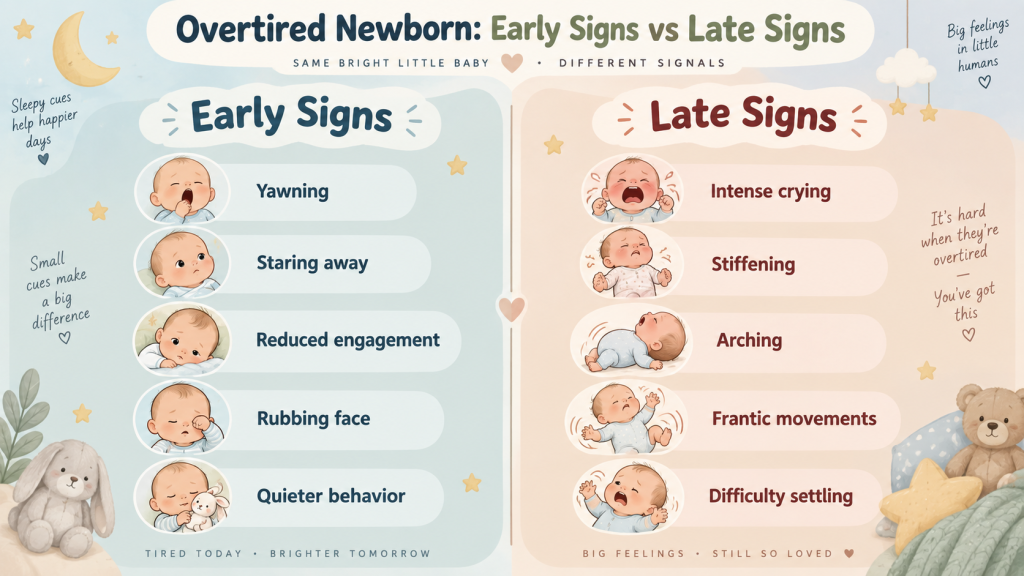
Early tired cues can include a distant stare, turning away, yawning, finger-sucking, or quieter engagement. Cleveland Clinic pediatric guidance also lists frowning and ear pulling among possible sleepy cues.
Later, an overtired newborn may cry harder, stiffen, arch, or become difficult to comfort. Look for several cues together.
Our guide to baby sleep cues explains early and late signals in more detail.

Overtired vs. Hungry, Gassy, or Overstimulated
A crying newborn is not automatically tired. Hunger may come with rooting and searching for the breast or bottle. Digestive discomfort can appear around feeds, while overstimulation may follow busy lights, voices, visitors, or handling.
Before deciding you have an overtired newborn, check feeding, burping, diapering, clothing, temperature, and illness signs. Then reduce stimulation. Repeated patterns are more useful than one difficult nap.
How Long Should Newborns Stay Awake?
Treat wake-window charts as rough planning tools, not exact rules. Newborns differ by age, feeding pattern, temperament, and previous sleep.
Count awake time from when your baby genuinely wakes, then watch the baby rather than only the clock. Feeding, burping, and diapering may fill much of a young newborn’s awake period.
If your overtired newborn repeatedly reaches intense crying before naps, begin winding down a little earlier.
Why an Overtired Newborn Can Be Harder to Settle
Once tiredness becomes distress, soothing can get harder. A baby who was quietly staring may soon be crying and reacting to each transfer.
Think of sleepy cues as traffic signals, not a countdown: early cues suggest slowing down, while late cues may mean extra help is needed.
When an overtired newborn fights sleep, constant bouncing, talking, lights, and strategy changes can add stimulation. Meet physical needs, reduce input, and use one calm settling approach.

What to Do Right Now When Your Newborn Is Overtired
Check hunger, diapering, temperature, and burping first. Then move somewhere dimmer and quieter and use calm repetition: holding, rocking, patting, or shushing.
Stop swaddling as soon as your baby starts showing signs of rolling, and do not use weighted swaddles.
For sleep, use a firm, flat, non-inclined infant surface, place baby on their back, and keep pillows, blankets, toys, and positioners out. If you are getting sleepy, prioritize a safe transfer.
Build a Flexible Newborn Sleep Rhythm
A rhythm works better than a timetable during the newborn weeks: feed, brief awake time, wind down, sleep, then repeat. Cluster feeding and ordinary life will rearrange the pattern.
Use normal light and interaction during daytime awake periods. At night, keep feeds and changes quieter and dimmer when practical; HealthyChildren gives similar advice.
Do not keep an overtired newborn awake hoping for longer sleep later.
Make the Sleep Environment Calm and Safe
Keep the sleep space simple: a firm, flat approved surface, fitted sheet, comfortable conditions, and little else. Darkness can reduce visual stimulation, while steady sound may soften household noise.
Keep sound machines away from the sleep surface at a modest volume, and keep curtains and cords well beyond reach.
The CDC recommends back sleeping, a firm flat surface, room-sharing without bed-sharing ideally for at least six months, and no soft bedding.
Recommended Products for an Overtired Newborn
Products cannot “fix” an overtired newborn, but a few well-chosen tools can make the wind-down more consistent. These options serve different needs rather than duplicating the same job.
| Product | Best for | Useful feature | Main consideration |
| Yogasleep Hushh | Travel and small spaces | Portable sound options | Keep volume modest and device away from baby |
| HALO SleepSack Swaddle | Adjustable newborn swaddling | Three-way positioning | Stop swaddling when rolling attempts begin |
| NICETOWN Blackout Curtains | Bright rooms | Full-light-blocking design | Secure hardware and keep cords/fabric away |
| Philips Avent Soothie | Babies who already use a pacifier | One-piece silicone design | Do not attach cords or clips for sleep |
| VTech VM819 | Non-WiFi monitoring | Dedicated parent unit | A monitor does not replace direct safe-sleep practices |
Yogasleep Hushh Portable White Noise Sound Machine
Best for: Travel and small living spaces
The Hushh is compact and rechargeable, with three sound choices, adjustable volume, an amber light, and a portability clip. It suits families who want a consistent sound cue without a large nursery device. Its strength is simplicity on the go; however, keep it out of the crib and use a conservative volume.
HALO 100% Cotton SleepSack Swaddle, 3-Way Adjustable Wearable Blanket, TOG 1.5, Baby Blue, Newborn, 0–3 Months
Best for: Parents who want an adjustable swaddle style
This cotton wearable swaddle allows arms-in, hands-to-face, or arms-out positioning with adjustable wings and a zipper. It offers flexibility without loose blankets. The key limitation is developmental: once a baby shows signs of trying to roll, swaddling should stop according to AAP guidance.
NICETOWN White 100% Blackout Curtains, 84 Inch Long, 2 Pieces
Best for: Nurseries with strong daylight or streetlight
These curtains use blackout construction intended to block incoming light, making a bright room easier to darken for naps or early bedtimes. They are most useful where light control is the main issue. Install hardware securely, and keep fabric, cords, and other window-covering hazards well away from the crib.
Philips Avent Soothie Baby Pacifier, 0–3 Months, 4-Pack, Green, SCF190/41
Best for: Young babies who already settle with sucking
This 0–3-month Soothie uses a one-piece medical-grade silicone design. It suits families whose baby already accepts a pacifier during settling. Some babies simply refuse pacifiers, which is fine. For sleep, never attach a pacifier to clothing, cords, toys, or clips.
VTech Baby Monitor No WiFi, VM819
Best for: Families who prefer a dedicated non-WiFi monitor
The VM819 has a 2.8-inch parent display, automatic night vision, two-way audio, a temperature sensor, lullabies, and soothing sounds. It suits families wanting monitoring without a phone or home WiFi. Remember, monitoring technology does not make an unsafe sleep setup safe or replace caregiver checks.
Research-Backed Guidance for an Overtired Newborn
Newborn sleep varies widely, which is why strict wake-window schedules should be treated as guides rather than rules. The American Academy of Sleep Medicine does not set a specific sleep-duration recommendation for babies younger than 4 months because normal patterns vary so much.
Safe sleep recommendations are clearer. The American Academy of Pediatrics recommends placing babies on their backs on a firm, flat sleep surface and keeping pillows, blankets, toys, and other soft items out of the sleep area.
The CDC’s infant safe-sleep guidance supports the same approach and recommends room-sharing without bed-sharing.
For an overtired newborn, the practical takeaway is to watch sleepy cues, respond to feeding and comfort needs, and begin winding down before fussiness becomes intense—while always keeping the sleep environment safe.
Common Mistakes That Can Make Settling Harder
Stretching awake time because “more tired” sounds like “more sleep” can backfire with an overtired newborn. Constantly switching soothing methods can also add stimulation.
More importantly, do not solve difficult settling with unsafe sleep products. Positioners, pillows, weighted sleep products, loose blankets, and inclined sleep surfaces are not substitutes for a safe infant sleep space. Feeding needs also come before schedule goals.
When Sleep Changes Need Medical Advice
Do not assume every unsettled newborn is overtired. Contact your pediatrician if sleep changes come with poor feeding, repeated vomiting, unusual lethargy, markedly fewer wet diapers, or persistent inconsolable crying.
For infants 3 months old or younger, the AAP recommends calling a pediatrician right away if a rectal temperature reaches 100.4°F (38°C) or above.
Very difficult waking, blue or gray coloring, significant breathing difficulty, new grunting, or a weak suck require urgent evaluation.
Frequently Asked Questions About an Overtired Newborn
How do I know if my newborn is overtired or just fussy?
Focus on the overall pattern instead of judging a single behavior on its own. Tiredness is more likely when fussiness follows awake time and appears with yawning, staring away, reduced engagement, or escalating crying. Check hunger, diapering, temperature, burping, and illness signs first. If your baby seems unusually unwell or difficult to wake, seek medical advice rather than assuming overtiredness.
How do I get an overtired newborn to sleep quickly?
There is no reliable instant method. Meet feeding and comfort needs, reduce stimulation, then use one calm approach such as holding, rocking, patting, or shushing. Once asleep, move your baby to a safe infant sleep surface on their back. If distress continues, reassess for hunger, discomfort, or illness.
Can a newborn become overtired after one missed nap?
Yes, a missed or unusually short sleep can leave some newborns fussier later, although babies vary. You do not need to repair the entire day. Offer the next sleep opportunity when tired cues appear, keep the wind-down quiet, and return to your flexible rhythm. One difficult nap does not ruin the schedule.
Should I follow newborn wake windows exactly?
No. Wake windows can remind you how long your baby has been awake, but they are not medical deadlines. A newborn may tire earlier after a short nap or stay calmly alert longer after good rest. Use timing with feeding needs, behavior, and repeated sleep cues rather than forcing sleep or wakefulness to match a chart.
Can I let my newborn sleep longer after an overtired day?
Sometimes, but feeding needs come first. Young newborns may need waking for feeds depending on age, weight gain, prematurity, jaundice, feeding method, and their clinician’s plan. Do not skip medically recommended feeds to catch up on sleep. If unsure about a longer stretch, ask the pediatrician who knows your baby’s growth and feeding history.
A Simple 24-Hour Mindset for Easier Newborn Sleep
After a rough nap, think one cycle ahead instead of trying to repair the whole day. Meet your baby’s needs, lower stimulation, offer sleep, and start fresh next waking.
Notice two or three cues that regularly appear before intense fussiness. If useful, jot down wake time, feed, first tired cue, and sleep time for a few days.
If the same overtired newborn pattern repeats, begin the calming routine slightly earlier rather than changing everything at once.
Final Recommendation for an Overtired Newborn
When you are dealing with an overtired newborn, focus first on needs and timing: feed appropriately, notice early sleepy cues, reduce stimulation, and offer sleep before fussiness becomes intense. Then keep the sleep setup simple and safe—back sleeping, a firm flat surface, and no loose or soft items.
Products are optional helpers. The Yogasleep Hushh makes sense when portability and steady sound matter, while the HALO SleepSack Swaddle may suit families who want an adjustable newborn swaddle before rolling begins. Neither replaces responsive care or safe-sleep practices.
Your most useful next step is to watch for your baby’s recurring early cues and start a short, calm wind-down when they appear. If sleep behavior suddenly changes or comes with concerning symptoms, contact your pediatrician.