Toddler Sleep Regression: Why It Happens and How to Get Back on Track

We may earn a commission for purchases made using our links. Please see our disclosure to learn more.
Your toddler was finally sleeping well, and then suddenly bedtime becomes a negotiation, naps fall apart, or 2 a.m. feels like party time. A toddler sleep regression can be exhausting because it often appears just when a routine seemed settled. The good news is that these changes usually make more sense once you look at development, sleep needs, naps, separation anxiety, and daily habits together.
This guide explains what may be disrupting your toddler’s sleep, what you can change without overhauling everything, which sleep-support products may be useful, and when it is worth calling your child’s pediatrician. The goal is not a perfect sleeper. It is a realistic routine your family can repeat.
Affiliate disclosure: We may earn a commission if you purchase through qualifying links, at no extra cost to you.
What Is a Toddler Sleep Regression?
Toddler sleep regression is a parent term for a period when a child who had been sleeping reasonably well starts resisting sleep, waking more often, rising early, or refusing naps. It is not a formal medical diagnosis, and there is no single test or exact timeline.
Sleep can shift because of development, illness, travel, schedule changes, a new sibling, moving to a bed, or simply a toddler learning that “one more story” can delay bedtime.
Why Toddler Sleep Regression Happens
Toddlers are learning quickly. New language, mobility, imagination, independence, and awareness of separation can all show up at night. A child who suddenly realizes a parent can leave may protest bedtime more intensely; another may rehearse new words instead of sleeping.
Meanwhile, sleep needs and naps evolve. A schedule that worked last month may now leave a child undertired at bedtime or overtired after a skipped nap. Look for what changed around the regression.

Common Signs Your Toddler’s Sleep Has Changed
A toddler sleep regression may mean longer settling, repeated requests after lights-out, new night wakings, earlier mornings, shorter naps, or sudden nap refusal.
Daytime behavior adds context. An unusually irritable or sleepy child may need more rest, while a cheerful toddler chatting in bed for an hour may not be ready to sleep yet. Track patterns for several days before changing multiple things at once.
How Long Does a Toddler Sleep Regression Last?
There is no evidence-based rule that a toddler sleep regression must last a certain number of days or weeks. The label covers several different problems, so duration depends on the cause.
A disruption after travel or illness may ease once routine returns. A nap transition or new bedtime habit can take longer. If sleep stays substantially disrupted, worsens, or affects daytime functioning, troubleshoot the schedule or speak with your pediatrician.
Check the Schedule Before Changing Your Strategy
Before changing bedtime rules, look at your toddler’s total sleep and when that sleep happens. The American Academy of Sleep Medicine recommends 11–14 hours of sleep per 24 hours for children ages 1–2 and 10–13 hours for children ages 3–5, including naps.
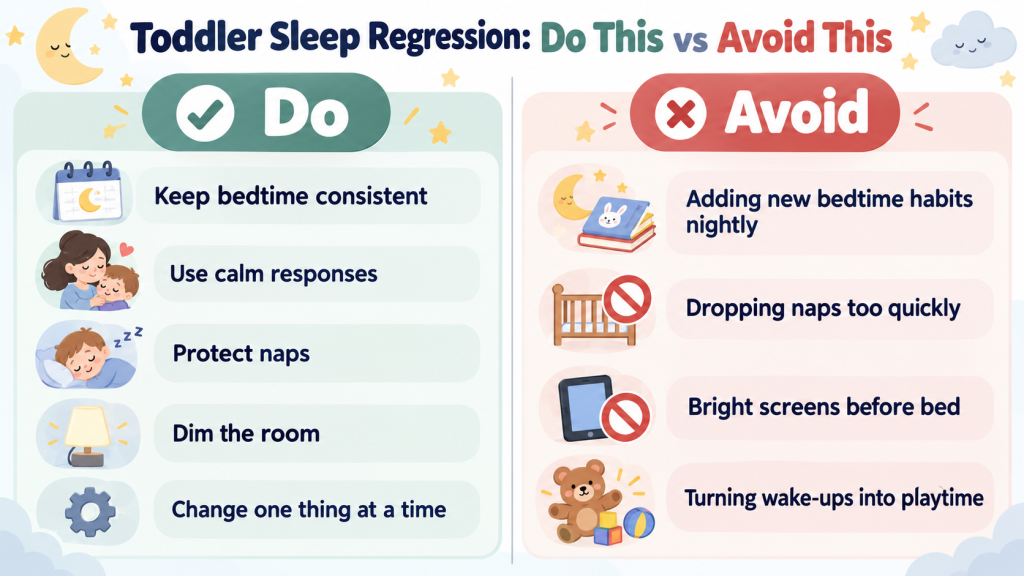
Then look at timing. A nap that ends too late may make bedtime difficult, while skipping a needed nap can leave a toddler overtired and harder to settle. Try changing one part of the schedule at a time rather than rebuilding the entire day after one bad night.
If your child is just moving into toddlerhood, this 12-month-old sleep routine guide offers a practical example of how naps, meals, bedtime, and common sleep disruptions can fit together. It can be especially useful when a toddler sleep regression appears alongside a changing nap schedule.
Build a Bedtime Routine Your Toddler Can Predict
A routine should be simple enough to repeat on busy nights: wash up, pajamas, teeth, one or two books, cuddle, then the same goodnight phrase. The exact activities matter less than their calm order and consistency. The American Academy of Pediatrics likewise recommends a quiet, consistent routine and a regular bedtime for toddlers.
Offer small choices inside firm boundaries: “blue pajamas or green?” instead of “do you want to go to bed?” Keep stimulating play and screens away from the final wind-down when possible, and resist adding new steps whenever bedtime gets difficult.

Handle Night Wakings Without Creating a Bigger Battle
When your toddler wakes, first check for a genuine need such as illness, pain, a wet bed, or discomfort. If they are well, keep your response calm and predictable.
Use low light, a quiet voice, and a short phrase such as, “It’s still sleep time. You’re safe.” The goal is not to ignore distress. It is to avoid turning each waking into a long conversation, snack, game, or new routine that becomes harder to unwind later.
Manage Nap Refusal, Early Waking, and Bedtime Stalling
Nap refusal does not always mean a toddler is ready to stop napping. Look at several days. If skipping it brings late-afternoon meltdowns or accidental dozing, daytime rest may still be needed.
For early waking, keep the room dark and the response consistent until your chosen morning time when practical. For stalling, handle predictable needs—water, toilet, one hug—before lights-out, then repeat the same brief response to extra requests.
Separation Anxiety and New Toddler Fears
Separation anxiety and imagination can make bedtime harder, even for a child who once waved goodnight happily. Respond warmly while keeping the sequence familiar.
A short check-in, consistent goodbye phrase, or age-appropriate comfort object may help. For fear of the dark, a dim night light can feel reassuring without making the room bright.
Talk about the bedtime plan during the day, too. Toddlers often handle boundaries better when they know what will happen before they are tired.
Shortened Research-Backed Section
Research-Backed Toddler Sleep Guidance
Research suggests that consistency and enough total sleep matter more than following a strict “sleep regression” schedule. The American Academy of Sleep Medicine recommends 11–14 hours of sleep per day for children ages 1–2 and 10–13 hours for ages 3–5, including naps.
A 2015 study of more than 10,000 young children found that regular bedtime routines were associated with earlier bedtimes, shorter settling times, fewer night wakings, and longer sleep. A later study of toddlers also linked more consistent bedtime routines with better sleep patterns.
The practical takeaway is simple: during a toddler sleep regression, focus on age-appropriate sleep, steady nap timing, and a predictable bedtime routine rather than constantly changing strategies.
Recommended Products for Toddler Sleep Regression
Products cannot cure toddler sleep regression, but they can make a consistent routine or sleep environment easier to maintain. These five options address different needs.
| Product | Best for | Useful feature |
| Hatch Rest 2nd Gen Baby Sound Machine & Night Light | All-in-one bedtime routines | Sound, light, and wake cues |
| Yogasleep Hushh Portable White Noise Sound Machine | Travel and shared rooms | Compact white noise |
| LittleHippo MELLA Kids Sleep Training Clock | Early risers | Color-based wake cues |
| FAMIDUO Dodo Duck Night Light | Bedtime reassurance | Dimmable portable light |
| NICETOWN White 100% Blackout Curtains, 84 Inch | Bright bedrooms | Light-blocking panels |
Hatch Rest 2nd Gen Baby Sound Machine & Night Light
Best for: Families who want one programmable routine device
Hatch Rest 2nd Gen combines sleep sounds, a night light, bedtime and time-to-rise cues, custom routines, and app control. It suits families who want the same signals for wind-down and morning without juggling several devices. The practical strength is consolidation. However, families who only need basic white noise may not use enough features to justify a more complex device.
Yogasleep Hushh Portable White Noise Sound Machine for Baby
Best for: Travel, shared rooms, and compact setups
The Hushh offers white noise, ocean, and rain sounds, adjustable volume, a soft amber light, and a toddler lock in a compact body. It is easy to move between home, grandparents’ houses, and trips. Portability is its main advantage; unlike a sleep trainer, however, it does not provide scheduled visual bedtime or wake cues.
LittleHippo MELLA Kids Sleep Training Clock, Night Light & Sound Machine
Best for: Toddlers who wake before the household is ready
MELLA uses colors and facial expressions as bedtime and ready-to-rise signals and also includes a night light, sleep sounds, alarm, and nap timer. Visual cues can be easier for toddlers to understand than clock time. Still, parents need to teach and consistently reinforce what each cue means rather than expecting the device alone to change sleep behavior.
FAMIDUO Dodo Duck Night Light
Best for: Toddlers who want a comforting bedside light
The FAMIDUO Dodo Duck Night Light provides a soft, dimmable glow and includes touch controls, rechargeable operation, and a 20-minute timer. Its portable design works well for bedtime reassurance or nighttime check-ins without relying on a bright room light. Keep in mind that a night light supports the sleep environment rather than addressing the underlying cause of a sleep regression.
NICETOWN White 100% Blackout Curtains 84 Inch Long for Bedroom, 2 Pieces
Best for: Bright bedrooms and early-morning light
These two-panel blackout curtains use an opaque lining designed to block outside light. They are practical when sunrise, streetlights, or daytime naps make darkness inconsistent. Their advantage is environmental control rather than another bedtime gadget. Measure the window and rod setup carefully before buying, since gaps around poorly fitted curtains can still let light into the room.
When a Sleep Problem Needs Pediatric Advice
Do not assume every difficult night is a toddler sleep regression. Contact your pediatrician about frequent snoring, breathing pauses or difficulty, unusual daytime sleepiness, persistent insomnia, pain, or major behavior changes.
The American Academy of Pediatrics flags habitual snoring and breathing problems as possible sleep-apnea signs that deserve medical attention. Seek urgent care for serious breathing difficulty, prolonged pauses, or concerning color changes.
A short sleep diary—bedtime, naps, wakings, snoring, illness, unusual events—can make that conversation more useful.
A Simple 7-Night Reset Plan for Toddler Sleep Regression
For one week, simplify instead of experimenting constantly. Choose a realistic wake time, nap window, and bedtime based on your child’s age and sleep needs. Repeat a short bedtime sequence in the same order.
During night wakings, use one calm response when your child is safe and well. In the morning, clearly start the day with light, breakfast, and normal activity.
Judge the seven-night pattern, not one rough night. If settling still takes a long time, adjust timing modestly. If your toddler seems exhausted, protect more sleep rather than adding stricter boundaries.
Toddler Sleep Regression FAQ
Is toddler sleep regression normal?
Temporary sleep disruption is common during toddlerhood, especially around development, separation anxiety, illness, travel, nap transitions, or environmental changes. However, “toddler sleep regression” is a descriptive label, not a diagnosis. If the change is persistent or comes with breathing problems, pain, or significant daytime symptoms, ask your child’s pediatrician.
What ages are most associated with toddler sleep regression?
Parents often discuss regressions around 12, 18, and 24 months, but research does not establish a universal regression calendar. Sleep disruption can happen whenever development or schedules change. Ask what changed—nap timing, language, separation anxiety, illness, travel, or bedtime habits—rather than assuming a particular age explains the problem.
Should I stop naps during a sleep regression?
Not automatically. A toddler who fights a nap for a few days may still need daytime sleep. If skipped naps bring late-afternoon meltdowns, accidental dozing, or unusually early sleepiness, your child may not be ready to drop it. Adjust timing gradually and compare several days before making a permanent change.
Can white noise help toddler sleep regression?
White noise can create a consistent sound backdrop and may mask household or street noise, but it does not treat the cause of a regression. Follow the sound machine’s instructions, keep the volume reasonable, and avoid using louder settings to force sleep. Treat it as an environmental cue, not a cure.
When should I worry about frequent night waking?
Call your pediatrician when waking is persistent or worsening, especially with habitual loud snoring, breathing pauses, gasping, pain, unusual movements, marked daytime sleepiness, or major behavior changes. Seek advice whenever something feels different from an ordinary bedtime struggle. Medical causes should be considered before treating every waking as behavioral.
Toddler Sleep Regression: What to Do Next
A toddler sleep regression feels much bigger at 2 a.m. Start with age-appropriate total sleep, nap timing, a predictable bedtime routine, calm responses to wakings, and a room that supports sleep. Change one thing at a time so you can see what helps.
If light or routine cues are part of the problem, NICETOWN blackout curtains or Hatch Rest 2nd Gen may support the environment, but they are tools, not cures. Most importantly, pay attention to breathing, pain, unusual daytime symptoms, and persistent disruption. The best next step is a simple plan your family can repeat, with pediatric guidance when something does not feel routine.